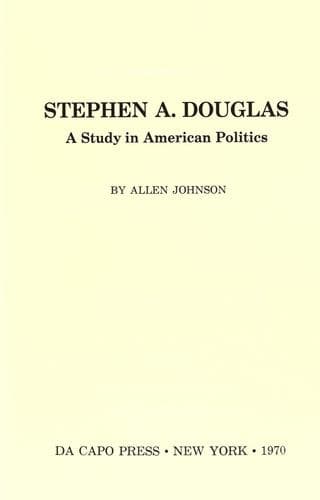
Stephen A. Douglas: A Study in American PoliticsJohnson, Allen
History
Stephen A. Douglas: A Study in American Politics
Johnson, Allen
Douglas, Stephen A. (Stephen Arnold), 1813-1861
In a debate which was precipitated by a resolution of Senator Pugh,
the old sores were rent open. Senator Davis of Mississippi was
particularly irritating in his allusions to the Freeport, and other
recent, heresies of the Senator from Illinois. In the give and take
which followed, Douglas was beset behind and before. But his fighting
blood was up and he promised to return blow for blow, with interest.
Let every man make his assault, and when all were through, he would
"fire into the lump."[812] "I am not seeking a nomination," he
declared, "I am willing to take one provided I can assume it on
principles that I believe to be sound; but in the event of your making
a platform that I could not conscientiously execute in good faith if I
were elected, I will not stand upon it and be a candidate." For his
part he would like to know "who it is that has the right to say who is
in the party and who not?" He believed that he was backed by
two-thirds of the Democracy of the United States. Did one-third of the
Democratic party propose to read out the remaining two-thirds? "I have
no grievances, but I have no concessions. I have no abandonment of
position or principle; no recantation to make to any man or body of
men on earth."[813]
Some days later Douglas made it equally clear that he had no
recantation to make for the sake of Republican support. Speaking of
the need of some measure by which the States might be protected
against acts of violence like the Harper's Ferry affair, he roundly
denounced that outrage as "the natural, logical, inevitable result of
the doctrines and teachings of the Republican party, as explained and
enforced in their platform, their partisan presses, their pamphlets
and books, and especially in the speeches of their leaders in and out
of Congress."[814] True, they disavowed the _act_ of John Brown, but
they should also repudiate and denounce the doctrines and teachings
which produced the act. Fraternal peace was possible only upon "that
good old golden principle which teaches all men to mind their own
business and let their neighbors' alone." When men so act, the Union
can endure forever as the fathers made it, composed of free and slave
States.[815] "Then the senator is really indifferent to slavery, as he
is reported to have said?" queried Fessenden. "Sir," replied Douglas,
"I hold the doctrine that a statesman will adapt his laws to the
wants, conditions, and interests of the people to be governed by them.
Slavery may be very essential in one climate and totally useless in
another. If I were a citizen of Louisiana I would vote for retaining
and maintaining slavery, because I believe the good of the people
would require it. As a citizen of Illinois I am utterly opposed to it,
because our interests would not be promoted by it."[816]
Public-domain text, read in full here on John Shaqi.
Reviews
Reviews
No reviews yet
Be the first to share your thoughts on this work.
Elsewhere in the archive
Join the Discussion
Join the discussion
Sign in to leave a comment or review.
Sign InorCreate an account