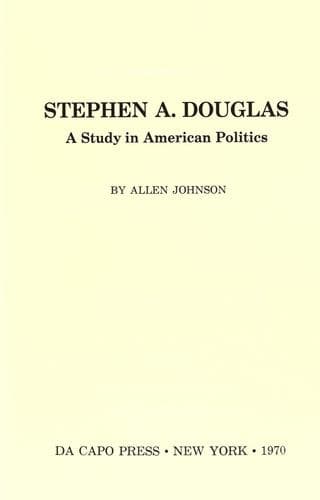
Stephen A. Douglas: A Study in American PoliticsJohnson, Allen
History
Stephen A. Douglas: A Study in American Politics
Johnson, Allen
Douglas, Stephen A. (Stephen Arnold), 1813-1861
Stripped of its rhetorical garb, Douglas's speech of January 27, 1846,
must be acknowledged to have a substratum of good sense and the
elements of a true prophecy. When it is recalled that recent
developments in the Orient have indeed made the mastery of the Pacific
one of the momentous questions of the immediate future, that the
United States did not then possess either California or Alaska, and
that Oregon included the only available harbors on the coast,--the
pleas of Douglas, which rang false in the ears of his own generation,
sound prophetic in ours. Yet all that he said was vitiated by a
fallacy which a glance at a map of the Northwest will expose. The line
of 49 deg. eventually gave to the United States Puget Sound with its
ample harbors.
Perhaps it was the same uncompromising spirit that prompted Douglas's
constituents in far away Illinois to seize the moment to endorse his
course in Congress. Early in January, nineteen delegates, defying the
inclemency of the season, met in convention at Rushville, and
renominated Douglas for Congress by acclamation.[215] History
maintains an impenetrable silence regarding these faithful nineteen;
it is enough to know that Douglas had no opposition to encounter in
his own bailiwick.
When the joint resolution to terminate the treaty of occupation came
to a vote, the intransigeants endeavored to substitute a declaration
to the effect that Oregon was no longer a subject for negotiation or
compromise. It was a silly proposition, in view of the circumstances,
yet it mustered ten supporters. Among those who passed between the
tellers, with cries of "54 deg. 40' forever," amid the laughter of the
House, were Stephen A. Douglas and four of his Illinois
colleagues.[216] Against the substitute, one hundred and forty-six
votes were recorded,--an emphatic rebuke, if only the ten had chosen
so to regard it.
Public-domain text, read in full here on John Shaqi.
Reviews
Reviews
No reviews yet
Be the first to share your thoughts on this work.
Elsewhere in the archive
Join the Discussion
Join the discussion
Sign in to leave a comment or review.
Sign InorCreate an account