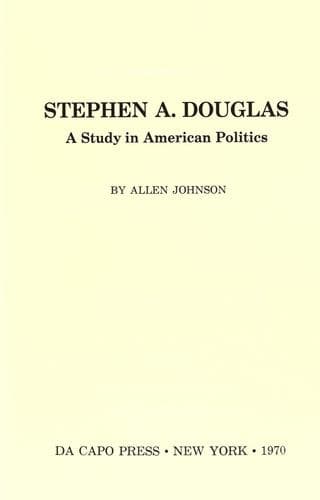
Stephen A. Douglas: A Study in American PoliticsJohnson, Allen
History
Stephen A. Douglas: A Study in American Politics
Johnson, Allen
Douglas, Stephen A. (Stephen Arnold), 1813-1861
Before the bill passed the House it was amended at one notable point.
Neither slavery nor involuntary servitude should ever exist in the
Territory, following the provision in the Ordinance of 1787 for the
Northwest Territory. Presumably Douglas was not opposed to this
amendment,[221] though he voted against the famous Wilmot Proviso two
days later. Already Douglas showed a disposition to escape the toils
of the slavery question by a _laissez faire_ policy, which was
compounded of indifference to the institution itself and of a strong
attachment to states-rights. When Florida applied for admission into
the Union with a constitution that forbade the emancipation of slaves
and permitted the exclusion of free negroes, he denied the right of
Congress to refuse to receive the new State. The framers of the
Federal Constitution never intended that Congress should pass upon the
propriety or expediency of each clause in the constitutions of States
applying for admission. The great diversity of opinion resulting from
diversity of climate, soil, pursuits, and customs, made uniformity
impossible. The people of each State were to form their constitution
in their own way, subject to the single restriction that it should be
republican in character. "They are subject to the jurisdiction and
control of Congress during their infancy, their minority; but when
they obtain their majority and obtain admission into the Union, they
are free from all restraints ... except such as the Constitution of
the United States has imposed."[222]
The absorbing interest of Douglas at this point in his career is
perfectly clear. To span the continent with States and Territories, to
create an ocean-bound republic, has often seemed a gross,
materialistic ideal. Has a nation no higher destiny than mere
territorial bigness? Must an intensive culture with spiritual aims be
sacrificed to a vulgar exploitation of physical resources? Yet the
ends which this strenuous Westerner had in view were not wholly gross
and materialistic. To create the body of a great American Commonwealth
by removing barriers to its continental expansion, so that the soul of
Liberty might dwell within it, was no vulgar ambition. The conquest of
the continent must be accounted one of the really great achievements
of the century. In this dramatic exploit Douglas was at times an
irresponsible, but never a weak nor a false actor.
The session ended where it had begun, so far as Oregon was concerned.
The Senate failed to act upon the bill to establish a territorial
government; the earlier bill to protect American settlers also failed
of adoption; and thus American caravans continued to cross the plains
unprotected and ignored. But Congress had annexed a war.
* * * * *
FOOTNOTES:
[Footnote 186: Message of December 3, 1844.]
[Footnote 187: _Globe_, 28 Cong., 2 Sess., p. 85.]
[Footnote 188: _Globe_, 28 Cong., 2 Sess., App., p. 65.]
[Footnote 189: _Ibid._, p. 66.]
Public-domain text, read in full here on John Shaqi.
Reviews
Reviews
No reviews yet
Be the first to share your thoughts on this work.
Elsewhere in the archive
Join the Discussion
Join the discussion
Sign in to leave a comment or review.
Sign InorCreate an account