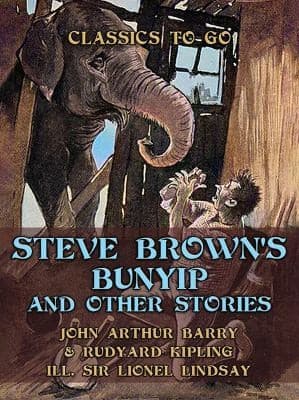
Steve Brown's Bunyip, and Other StoriesBarry, John Arthur
General
Steve Brown's Bunyip, and Other Stories
Barry, John Arthur
Australia -- Fiction; Sea stories; Short stories
‘I looked at him. “Yes,” he continued, “the old volcano is showing
every indication of renewed activity. We came here to observe the
transit of Venus, but shall have probably to pack up and form another
station if those symptoms don’t subside. See there!”
‘Looking in the direction of his outstretched finger, I saw several
tall puffs of what seemed like white smoke issuing from the depths of
the crater.
‘The observers were loth to shift their quarters; but, when some
red-hot cinders from below set one of the tents on fire, they accepted
the hint.
‘Still in my hammock, I was presently carried down the mountain and on
board H.M.S. _Hygeia_, where, with careful and skilled attention, I
soon recovered.’
The Captain ceased speaking. For a time nothing was heard except the
steady blast of the ‘Roaring Forties’ overhead.
Asked a passenger presently,—
‘And did the volcano really explode after all?’
‘It did, indeed,’ replied Captain Marion; ‘but not for a month
afterwards, and then so fiercely as to scatter death and destruction
throughout those narrow seas, grinding the island of Krakatoa itself
into cosmic dust—visible, according to scientists, nearly all over the
world.’
* * * * *
Here ends the story proper as compiled from the notes taken by one of
the passengers and jotted down in his cabin of a night as the Captain
finished each section of his narrative.
Lower down on the last pages of these notes is gummed, however, a
printed paragraph, cut from a Sydney daily newspaper, which runs as
follows:—
MARION—HILLIER.—On the 29th ultimo, at St James’s Church of
England, Sydney, by the Rev. R. Garnsey, George Wreford Marion,
master in the British Mercantile Marine, to Amy Margaret, daughter
of the late John Hillier, Esq., of Pevensey, Miller’s Point,
Sydney, and Eurella and Whydah stations, Riverina, N.S.W.
‘DOT’S CLAIM.’
It was evening in the German Arms at Schwartzdorf. Great fires blazed
in all the rooms of that old-fashioned hostelry, welcome enough on
entering from the chill, wild weather ruling over the mountainland
outside.
Tired with a heavy day’s work at inspecting the mining claims, which
were beginning to attract notice to this secluded spot, it was with a
feeling of satisfaction that, after tea, I drew a chair up to the
fire, lit my pipe, and made myself comfortable.
Presently there was a knock at the door and, in response to my ‘Come
in,’ there entered the man who told me this story.
In his hand he carried a canvas bag, whose contents he emptied on the
table with the remark, ‘I thought perhaps you might like to see
these.’
Very beautiful they were, without doubt—quartz, ironstone and gold,
mingled in the most fantastic manner; grotesque attempts by Nature’s
untrained fingers at crosses, hearts, stars, and other shapes defying
name.
Public-domain text, read in full here on John Shaqi.
Reviews
Reviews
No reviews yet
Be the first to share your thoughts on this work.
Elsewhere in the archive
Join the Discussion
Join the discussion
Sign in to leave a comment or review.
Sign InorCreate an account