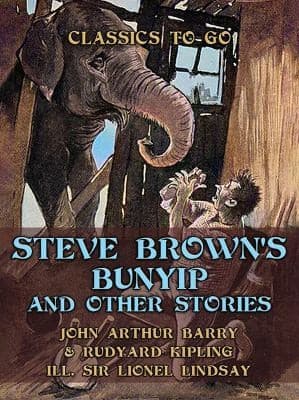
Steve Brown's Bunyip, and Other StoriesBarry, John Arthur
General
Steve Brown's Bunyip, and Other Stories
Barry, John Arthur
Australia -- Fiction; Sea stories; Short stories
‘I think it was two years afore we got a crop o’ anythin’. Then it was
potaters. When we tried to sell ’em we couldn’t get an offer.
Everybody had potaters. So we just turned to an’ lived on ’em. They’re
fillin’, doubtless. But potaters and fish, an’ fish an’ potaters for a
change, all the year round, gets tiresome in the long run.
‘I often wonder now what could have possessed me an’ Bill to go in for
such a thing as farmin’. But there, when a chap’s luck’s out diggin’,
he’s glad to tackle anythin’ for a change!
‘Presently one or two more, men with fam’lies, settles close to us and
tries to make a livin’. It didn’t amount to much. Then up comes a
string o’ Germans, trampin’ along from the coast, carryin’ furniture
an’ tools, beds—ay, even their old women—on their backs. An’ they
settles, an’ starts the same game—clearin’, an’ ploughin’, an’ sowin’.
But I couldn’t see as any of ’em was makin’ a pile. They worked like
bullocks, women an’ all, late an’ early. The harder they worked, the
poorer they seemed to get. Bill an’ me had a pound or two saved up for
a rainy day. But they had nothin’; an’ how they lived was a mystery.
So, you see, takin’ things all round, it was high time somethin’
turned up. An’ somethin’ did. The next farm to us belonged to a
married couple. He was a runaway sailor. She’d been a passenger on
board. They had one child, just turned four year old, an’ they was
both fair wrapped up in that kid.
‘If Dot’s—Dot was his pet name—finger only ached, the work might go to
Jericho.
‘An’ indeed he were a most loveable little chap. With regards to him,
we was all of us ’most as bad as the father an’ mother, the way we
played with him an’ petted him. There was no denyin’ Dot of anythin’
once he looked at you out o’ those big blue eyes o’ his. And the
knowledgeableness of him! No wonder Jim Fairleigh an’ his missis
thought the sun rose every mornin’ out o’ the back o’ their boy’s
neck.’
Here Ward paused and queried,—
‘Married man, sir?’
‘No,’ I replied.
‘No more ’m I,’ he continued, ‘or I don’t s’pose I’d be here yarning a
night like this.’
‘It’s a wonder,’ I said, ‘that none of these jolly-looking _Fräuleins_
about here have been able to take your fancy.’
‘Well, to tell the truth,’ he replied, with, however, a rather
conscious expression on his face, ‘I think what those poor Fairleighs
went through rather scared me of marryin’.
‘But, as I was sayin’, farmin’ didn’t seem to agree with my mate,
Bill—that’s him you seen at the claim to-day—spite o’ his past
experience, any more’n it did with me. _He_ done the business,
by-the-bye, quite lately with a bouncin’ gal—Lieschen Hertzog—an’ now
stays at home o’ nights.
‘We had a note or two left. We had also a crop o’ potaters an’ some
punkins. But no one wanted ’em—wouldn’t buy ’em at any price. In fact,
you couldn’t give ’em away in those times.
‘The Fairleighs an’, I think, all of us, were pretty much in the same
box. As I said before, it was time somethin’ turned up.
Public-domain text, read in full here on John Shaqi.
Reviews
Reviews
No reviews yet
Be the first to share your thoughts on this work.
Elsewhere in the archive
Join the Discussion
Join the discussion
Sign in to leave a comment or review.
Sign InorCreate an account