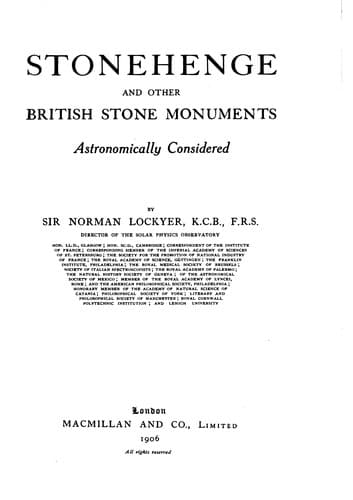
Stonehenge and Other British Stone Monuments Astronomically ConsideredLockyer, Norman, Sir
History
Stonehenge and Other British Stone Monuments Astronomically Considered
Lockyer, Norman, Sir
Druids and Druidism; Great Britain -- Antiquities; Stonehenge (England); Sun worship; Temples
“In a statistical account of the parish of Dungiven, written in 1813, it
is stated that at the well of Tubberpatrick, after performing the usual
rounds, devotees wash their hands and feet with the water and tear off a
small rag from their clothes, which they tie on a bush overhanging the
well; from whence they all proceed to a large stone in the River Roe,
immediately below the old church, and having performed an oblation they
walk round the stone, bowing to it, and repeating prayers as at the
well. Their next movement is to the old church, within which a similar
ceremony goes on, and they finish this rite by a procession and prayers
round the upright stone.”
5. _Time of the chief festival._--On this point there is not a great
quantity of precise information, but what we have points to May 1 as
being about the time when the holy wells are most frequented and
considered most efficacious.
This lack of information arises from the fact that the existence of the
May year in prehistoric times has not been even dreamt of by those who
have compiled the various accounts of the fast fading traditions, and in
very many instances a reference to an unknown saint’s day is the only
information given as to the time of the annual celebration. Wide
generalisation, therefore, from the material at hand is risky.
I will refer in the first instance to the May worship, and begin with
the famous Madron well in Cornwall, the walls of which I found to be
oriented to the May sunrise, so that the priest officiating at the altar
would face the sunrise. Quiller-Couch (p. 137) thus refers to what
happened there.
“Children used to be taken to this well on the first three Sunday
mornings in May to be dipped in the water, that they might be cured of
the rickets, or any other disorder with which they were troubled. Three
times they were plunged into the water, after having been stripped
naked; the parent, or person dipping them, standing facing the sun;
after the dipping they were passed nine times round the well from east
to west; then they were dressed and laid on St. Madern’s bed; should
they sleep, and the water in the well bubble, it was considered a good
omen. Strict silence had to be kept during the entire performance, or
the spell was broken. At the present time the people go to the well in
crowds on the first Sunday in May, when the Wesleyans hold a service
there, and a sermon is preached; after which the people throw in two
pins or pebbles to consult the spirit, or try for sweethearts; if the
two articles sink together, they will soon be married.
“Here divination is performed on May morning by rustic maidens anxious
to know when they are to be married. Two pieces of straw about an inch
long are crossed and transfixed with a pin. This, floated on the waters,
elicits bubbles, the number of which, carefully counted, denotes the
years before the happy day.”
Public-domain text, read in full here on John Shaqi.
Reviews
Reviews
No reviews yet
Be the first to share your thoughts on this work.
Elsewhere in the archive
Join the Discussion
Join the discussion
Sign in to leave a comment or review.
Sign InorCreate an account