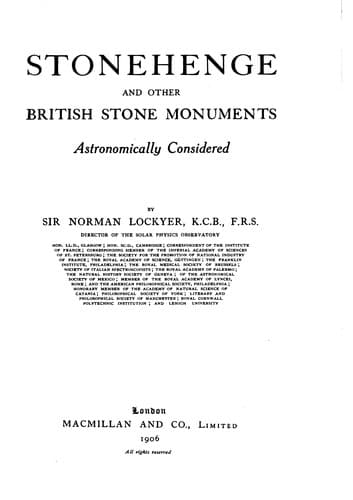
Stonehenge and Other British Stone Monuments Astronomically ConsideredLockyer, Norman, Sir
History
Stonehenge and Other British Stone Monuments Astronomically Considered
Lockyer, Norman, Sir
Druids and Druidism; Great Britain -- Antiquities; Stonehenge (England); Sun worship; Temples
“Have you beheld, when people pray
At St. John’s well on Patron-Day,
By charm of priest and miracle,
To cure diseases at this well;
The valleys filled with blind and lame,
And go as limping as they came.”
At Barnwell (Beirna-well = youths’ well), near Cambridge, the festival
took place on St. John’s Day.[82]
Brand, in his history of Newcastle (ii. 54), refers to a well still
called Bede’s Well, near Jarrow. “As late as 1740 it was a prevailing
custom to bring children troubled with any disease or infirmity; a
crooked pin was put in, and the well laved dry between each dipping. My
informant has seen twenty children brought together on a Sunday, to be
dipped in this well, at which also, on Midsummer Eve, there was a great
resort of neighbouring people, with bonfires, music, etc.”
Hope gives references to seven wells dedicated to “St. John,” one to
“St. John the Baptist,” and four to St. Peter. These _may_ have been
solstitial wells, but the information given is very slight and not to
the present point. He states (xxii) that the most important celebrations
were first held in May and at the summer solstice. He then adds, “later
Easter and Ascensiontide were the favoured seasons.” May, Summer
Solstice and Easter was, I think, the true order.
Finally, I may refer to the earliest holy well known to history. This is
the famous well at Heliopolis where Rā used to wash himself, and
Piankhi, B.C. 740, went and washed his face in it. At this same well the
Virgin sat and washed her Son’s swaddling bands in it. Its water made
the balsam trees to grow. It is now called by the Arabs “The Fountain of
the Sun” ‘Êyn ash-Shems.
[53] The literature that I have chiefly consulted is as follows:--
R. C. Hope _Holy Wells; their Legends and Traditions._
R. L. Quiller-Couch _Ancient and Holy Wells of Cornwall._
W. G. Wood-Martin _Traces of the Elder Faiths of Ireland._
G. L. Gomme _Ethnology in Folklore._
Prof. Rhys _Celtic Folklore, Manx and Welsh._
W. C. Borlase _Dolmens of Ireland._
S. Baring-Gould _A Book of the West._
[54] _Traces of the Elder Faiths of Ireland, A Folklore Sketch_, ii., p.
47.
[55] Pp. 11, 47.
[56] _Celtic Folklore, Manx and Welsh_, ii., p. 366.
[57] Wood-Martin, _loc. cit._, ii., p. 80.
[58] _Standing Stones and Maeshowe of Stenness_, by Magnus Spence, p.
13.
[59] That is from W. to E. through N., or E. to W. through S.; in the
same direction as the hands of a clock.
[60] _The Dolmens of Ireland_, i., p. 3.
[61] _Ibid._, pp. 95, 765.
[62] _Celtic Folklore, Manx and Welsh_, i., p. 332.
[63] Borlase, _loc. cit._, p. 760.
[64] _Ibid._, p. 426.
[65] Rhys, _Celtic Folklore, Manx and Welsh_, p. 363.
[66] _Pagan Ireland_, p. 160.
[67] Rhys, _Celtic Folklore, Manx and Welsh_, i., pp. 354, 356, 357, &c.
[68] Rhys, _ibid._, p. 332.
[69] _Ethnology in Folklore_, p. 78.
[70] Sikes: _British Goblins_, p. 351.
[71] Sikes, _idem._, p. 329.
Public-domain text, read in full here on John Shaqi.
Reviews
Reviews
No reviews yet
Be the first to share your thoughts on this work.
Elsewhere in the archive
Join the Discussion
Join the discussion
Sign in to leave a comment or review.
Sign InorCreate an account