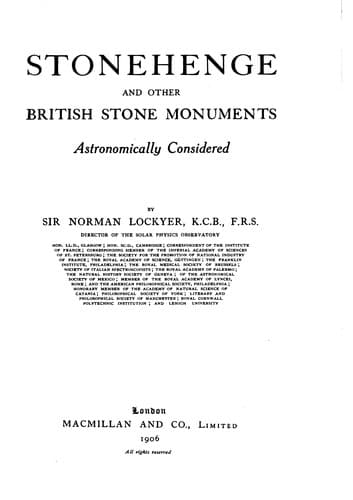
Stonehenge and Other British Stone Monuments Astronomically ConsideredLockyer, Norman, Sir
History
Stonehenge and Other British Stone Monuments Astronomically Considered
Lockyer, Norman, Sir
Druids and Druidism; Great Britain -- Antiquities; Stonehenge (England); Sun worship; Temples
“Burton says it extends throughout northern Africa from west to east;
Mungo Park mentions it in western Africa; Sir Samuel Baker speaks of it
on the confines of Abyssinia, and says that the people who practised it
were unable to assign a reason for doing so; Burton also found the same
custom in Arabia during his pilgrimage to Mecca; in Persia Sir William
Ouseley saw a tree _close to a large monolith_ covered with these rags,
and he describes it as a practice appertaining to a religion long since
proscribed in that country; in the Dekkan and Ceylon Colonel Leslie says
that the trees in the neighbourhood of wells may be seen covered with
similar scraps of cotton: Dr. A. Campbell speaks of it as being
practised by the Limboos near Darjeeling in the Himalaya, where it is
associated, as in Ireland, with large heaps of stones; and Huc in his
travels mentions it among the Tartars.”
The astronomical facts given in this book, gathered from a study of the
monuments in these islands, can only give us information touching the
introduction of the combined worship here.
My investigations have strongly suggested, to say the least, that there
were men here with knowledge enough to utilise the movements of the sun
and stars for temple, and no doubt practical purposes before 2000 B.C.,
that is, a thousand years before Solomon was born, and at about the time
that the Hecatompedon was founded at Athens.
If this is anywhere near the truth, these men must have been
representatives of a very old civilisation.
Now the civilisation principally considered by archæologists in
connection with the building of the monuments which I have studied is
the Aryan, of which the Celts formed a branch. This view, however, is
not universally held; the late General Pitt-Rivers, and I know of no
higher authority, stated his opinion that “The megalithic monuments...
take us back to pre-Aryan people, and suggest the spread of this people
over the area covered by their remains.”[88]
Mr. Gomme is of the same opinion (p. 27):
“Ceremonies which are demonstrably non-Aryan in India, even in the
presence of Aryan people, must in origin have been non-Aryan in Europe,
though the race from whom they have descended is not at present
identified by ethnologists.”
Sergi also points out:--
“Indo-Germanism led to almost entire forgetfulness of the most ancient
civilisations of the earth, those born in the valleys of the Euphrates
and the Tigris, and in the valley of the Nile; no influence was granted
to them over Greco-Roman classic civilisation, almost none anywhere in
the Mediterranean.”[89]
Public-domain text, read in full here on John Shaqi.
Reviews
Reviews
No reviews yet
Be the first to share your thoughts on this work.
Elsewhere in the archive
Join the Discussion
Join the discussion
Sign in to leave a comment or review.
Sign InorCreate an account