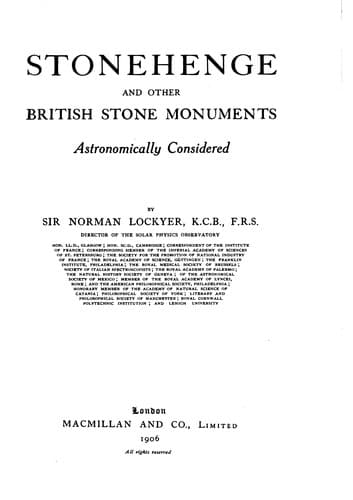
Stonehenge and Other British Stone Monuments Astronomically ConsideredLockyer, Norman, Sir
History
Stonehenge and Other British Stone Monuments Astronomically Considered
Lockyer, Norman, Sir
Druids and Druidism; Great Britain -- Antiquities; Stonehenge (England); Sun worship; Temples
The old idea that the ancient merchants could make a course from Ushant
to, say, Falmouth or Penzance need no longer be entertained; the
crossing from Africa to Gibraltar and from Cape Grisnez to Sandwich were
both to visible land, _i.e._ coastwise. The cliffs on the opposite land
are easily seen on a clear day.
Hence it would have been easier before the days of astronomical
knowledge and compasses to have reached England, and therefore Ireland
and the Orkneys, than to get to some of the islands in the
Mediterranean itself.[93]
It is seen then that it is possible that Semites might have built our
stone monuments between 2000 and 1200 B.C., while it is quite certain
that the Aryans did not build them, if the archæologists are not widely
wrong in their dates.
Let us, then, begin our inquiries by considering the information
available with regard to the Semites. Let us see in the first instance
whether they had stone monuments, and sacred trees and sacred wells; a
system of worship; and whether this worship was connected with the sun
and stars.
It is fortunate for us in this matter that one of the most fully
equipped scholars which the last century produced, Robertson Smith,
devoted his studies for many years to _The Religion of the Semites_, and
information on the points raised is to our hand; all I need do is to
give as shortly as possible a statement of the various conclusions he
had reached on the points to which our attention may in the first
instance be confined. I quote from his book _The Religion of the
Semites_.
The Semites include the Babylonians, who spoke a Semitic dialect, for
there were Sumerian speaking peoples among them, Assyrians, Phœnicians,
Hebrews, Arabs and Aramæans, who in ancient times occupied the fertile
lands of Syria, Mesopotamia and Irak from the Mediterranean coast to the
base of the mountains of Iran and Armenia. They also embrace the
inhabitants of the great Arabian peninsula, which is believed to have
been the centre of dispersion.
The ordinary artificial mark of a Semitic sanctuary was the sacrificial
pillar, cairn, or rude altar (p. 183): it was a fixed point where,
according to primitive rule, the blood of the offering was applied to
the sacred stones; or where a sacred tree, as we shall see presently,
was hung with gifts; the stones and tree being symbols of the God (p.
151).
Further, it is certain that the original altar among the northern
Semites was a great unhewn[94] stone, or a cairn, at which the blood of
the victim was shed (p. 185).
Monolithic pillars or cairns of stones are frequently mentioned in the
more ancient parts of the Old Testament as marking sanctuaries; Shechem,
Bethel, Gilead, Gilgal, Mizpah, Gibeon, and En-Rogel are referred to (p.
186).
Public-domain text, read in full here on John Shaqi.
Reviews
Reviews
No reviews yet
Be the first to share your thoughts on this work.
Elsewhere in the archive
Join the Discussion
Join the discussion
Sign in to leave a comment or review.
Sign InorCreate an account