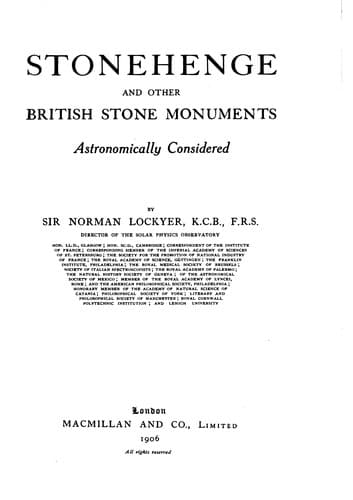
Stonehenge and Other British Stone Monuments Astronomically ConsideredLockyer, Norman, Sir
History
Stonehenge and Other British Stone Monuments Astronomically Considered
Lockyer, Norman, Sir
Druids and Druidism; Great Britain -- Antiquities; Stonehenge (England); Sun worship; Temples
But although these subjects are apparently distinct, I think my readers
will agree that the study of each has led to an identical result,
namely, that in early times it was a question of the May year, and that
the solstitial year was introduced afterwards. This was the chief
revelation of the monuments when they were studied from the astronomical
point of view.
Without confirmation from some other sources this result might have been
considered as doubtful, and the orientation theory might have been
thought valueless. It has, however, been seen that folklore and
tradition confirm it up to the hilt. I think it may be said, therefore,
that the theory I put forward in this book touching the astronomical use
of our ancient temples is so far justified.
The British monuments I had considered before this appeal to tradition
was made were the circles at Stonehenge, Stenness, The Hurlers and
Stanton Drew, and the avenues on Dartmoor. These were studied generally,
the main special result being that to which I have referred; we not only
found alignments to sunrise and sunset on the critical quarter-days of
the May years, but we found alignments to the stars which should have
been observed either at rising or setting to control the morning
sacrifices.
But this inquiry had left out of account several circles in south-west
Cornwall, of which I had vaguely heard but never seen. When I had
written the previous chapters showing how fully May-year practices are
referred to in the folklore of that part of the country, I determined to
visit the circles, dealing with them as test objects in regard to this
special branch of orientation. I had not time to make a complete survey;
this I must leave to others; but with the help so readily afforded me,
which I shall acknowledge in its proper place, I thought it possible in
a brief visit to see whether or not there were any May-year alignments.
In the following chapters I will give an account of the observations
made, but before doing so, in order to prove how solid the evidence
afforded by the Cornish monuments is, I will state the details of the
local astronomical conditions depending upon the latitude of the Land’s
End region, N. 50°. In the chapter containing some astronomical hints to
archæologists I referred (p. 122) to the solstice conditions for
Stenness beyond John o’ Groat’s, because those conditions afforded a
special case, the solstice being determined by the arrival of the sun at
its highest or lowest declination, which happens on particular dates
which recur each year. But with regard to the May year, during the
first week of May the sun’s declination is changing by over a quarter of
a degree daily, so that we must not expect to find the declination of
16° 20′ (see p. 22) rigidly adhered to.
Public-domain text, read in full here on John Shaqi.
Reviews
Reviews
No reviews yet
Be the first to share your thoughts on this work.
Elsewhere in the archive
Join the Discussion
Join the discussion
Sign in to leave a comment or review.
Sign InorCreate an account