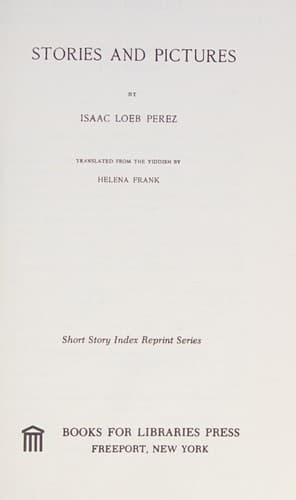
Jewish fiction; Jews -- Fiction; Peretz, Isaac Leib, 1851 or 1852-1915 -- Translations into English; Short stories
Life and peace to my sister Mistress Hannah.
I have received your second letter. It was soaked with tears and full of
insults directed against me, my wife Eva Gütel, and even the bride,
Beile-Sasha, and it has upset me very much, for why? You say, sister
Hannah, that I am a bandit, that I met you, heaven forbid, in a wood,
and, heaven forbid, murdered you; that it was I and my wife, Eva Gütel,
who drove you from the house; that Beile-Sasha, in your opinion, is a
hussy, because she is ordering silk dresses--what am I to say? I must
listen in silence, knowing the trouble you are in--that it is not you
that speak, but your heavy heart.
But it is not as you think. I am no murderer, thank heaven! And were any
one to come from the street and declare that the cloak I am wearing is
his, and that he is going to law about it, I should go with him to the
rabbi's without a word. And if, God willing, you come to the wedding, we
will go together and have it out.
And see here: About the board you did not eat, you confess yourself in
your letter that it came about through a quarrel between you and my wife
(it's not my affair who began it), and all I see is, that your husband
was a great booby--"that he followed after his wife." They say that you
ran away in the evening following Sabbath, and made yourselves a
laughing-stock. Our father was greatly distressed, and it shortened his
days (he said so plainly--neighbors heard it), and you put it all on Eva
Gütel! It's a calumny!
But what is done, is done! Our father lies in his grave. There can be no
more question of board or anything else.
And you know very well that Beile-Sasha, the bride, is no hussy. She,
poor thing, is quite innocent in the matter. Her future father-in-law,
the Takif,[119] forced me to order the silk dresses. Once even she
cried, and said it would ruin us, but what am I to do, when the contract
says "in dresses of silk and satin," and he will hear of no
alteration--it's take it or leave it. And there would be no choice but
to see my daughter an old maid.
And you know the dowry will not be given entirely in cash. I have
promised six, and given three, hundred rubles; I have mortgaged the
house for two hundred rubles, and you know the house stands in our
father's name, so that I had to pay extra--and now I am so short of
money that may God have mercy on me.
But what is the use of telling that to a woman! Our sages were right
when they said: "Women are feather-brained," and there is the proverb:
"Long hair (in girls, of course) and short wits." I shall write
separately to your husband; he is a man learned in the Law, and he will
know that one human being should not lean upon another, because, as we
are told, a human being can only just support himself. One must have
faith.
Public-domain text, read in full here on John Shaqi.
Reviews
Reviews
No reviews yet
Be the first to share your thoughts on this work.
Elsewhere in the archive
Join the Discussion
Join the discussion
Sign in to leave a comment or review.
Sign InorCreate an account