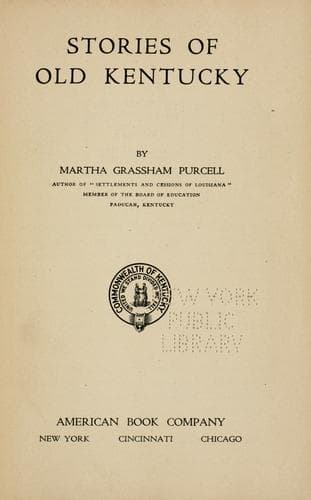
Stories of Old KentuckyPurcell, Martha C. Grassham, Mrs.
History
Stories of Old Kentucky
Purcell, Martha C. Grassham, Mrs.
Kentucky -- History
Lexington, then the Athens of the West, was for many years the home of a
native Kentuckian, a Mr. Barlow, whose fertile mind made him the most
celebrated of this group of interesting inventors. Having built a
steamboat at Augusta, after his removal to Lexington, he invented in
1826-1827 a steam locomotive for a railroad with a car attached for two
passengers, with power to ascend an elevation of eighty feet to a mile.
An oval track was constructed for it in a room. It was opened to the
public for exhibition and several took rides at fifty cents a ticket on
the first "railroad train" ever run successfully in western America.
This was sold to a Mr. Samuel Robb, who exhibited the novelty at various
cities including Louisville, Nashville, Memphis, and New Orleans; at the
latter place it was burned while on exhibition. In 1837 Mr. Barlow built
another locomotive and likewise sold it to a person who traveled and
exhibited it.
The versatile mind of Mr. Barlow also produced a nail and tack machine,
which was at once purchased and put into use by some capitalists. His
rifled cannon, invented in 1840, patented later, caused Congress to
appropriate three thousand dollars for an experimental gun, which, when
finished and tested, was of greater accuracy and range than was even
expected, and which is believed to have suggested most of the rifled
guns since patented in both America and Europe.
The crowning invention of this great genius was his wonderfully complex
production, a planetarium, that perfectly imitated the motions of the
solar system, the first and only instrument of the kind in the world.
This was so perfected as to produce the minute relative revolutions of
the planets. The first instrument was sold to Girard College,
Philadelphia. A number of small ones were later made for colleges and
institutions, and one large one for the Military Academy at West Point,
one for the Naval Academy at Annapolis, and one for New Orleans.
Some of these brought two thousand dollars each. One was exhibited at
the World's Fair Exhibition, Paris, France, 1867, as Kentucky's
contribution, and received the highest premium awarded any illustrative
apparatus.
THE MAN WHO KNEW ABOUT BIRDS
Kentucky is noted for her great hunters, Indian fighters, orators, and
statesmen. But there also lived in this state for awhile--some of the
time at Louisville, part of the time at Henderson--a man who knew more
about birds than any one had ever learned before.
Public-domain text, read in full here on John Shaqi.
Reviews
Reviews
No reviews yet
Be the first to share your thoughts on this work.
Elsewhere in the archive
Join the Discussion
Join the discussion
Sign in to leave a comment or review.
Sign InorCreate an account