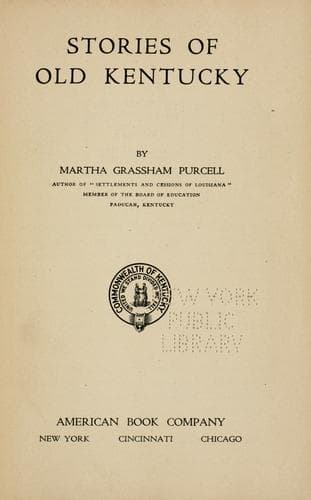
Stories of Old KentuckyPurcell, Martha C. Grassham, Mrs.
History
Stories of Old Kentucky
Purcell, Martha C. Grassham, Mrs.
Kentucky -- History
With a heart heaving with emotion and eyes dim with tears, the executive
hastily affixed his name and the seal of the commonwealth to a small
piece of paper, and, handing it to Larkin Liles, said in a husky voice,
"Mr. Liles, go home to your family and kiss the little ones for me. You
shall never enter the penitentiary while Clark is governor of Kentucky."
THE "PRIDE OF THE PENNYRILE"[3]
It is eminently proper that the metropolis of "Jackson's Purchase"
should bear a name of Indian origin. Although the greater part of
Kentucky, with its fertile meadowlands, towering forests, and tangled
cane-brakes, was only the hunting ground of the red men, yet all that
territory in Kentucky and Tennessee lying between the Tennessee and
Mississippi rivers was the home of the Chickasaw Indians. This large
tribe had their main town at Chickasaw Bluffs, where Memphis now stands,
with a number of other settlements scattered throughout this seven
million acres of fertile lands.
As Kentucky was once a part of Virginia, and as the "Old Dominion" was a
British colony, this section was once claimed by Great Britain. After
the Revolutionary War, Virginia, relying on the former policy of the
mother country, that,
"They should take who have the power,
And they should keep who can,"
allowed George Rogers Clark, in recognition of his services in the
Northwest Territory, to enter several thousand acres of land, including
the present site of the capital of McCracken County.
At that time there were no white settlements in this section; but as
early as the year 1806 or 1807 there was a flatboat landing and woodyard
at the mouth of the Tennessee River, kept by a genial Irishman named Pat
Dugan. The first name given the place, and the one by which it was known
for many years, was Pekin.
On October 19, 1818, through Governor Isaac Shelby and General Andrew
Jackson, commissioners, the United States bought from the Chickasaw
Indians their tract referred to above, which in the present state of
Kentucky includes the counties of Ballard, Calloway, Carlisle, Fulton,
Graves, Hickman, Marshall, and McCracken.
For many years the hero of Kaskasia, Cahokia, and Vincennes had been
infirm and poor. We all remember the touching scene when the Virginia
commission presented him a sword in recognition of his great services to
the United States; the old soldier listened in gloomy silence for a
while and, finally, thrusting the sword into the ground and breaking it,
he exclaimed, "When Virginia needed a sword I found one. Now I want
bread!" By the treaty just mentioned the title of George Rogers Clark
was made clear, but as he had died a few months previous to this his
tract passed to his brother, General William Clark, of St. Louis, who
had accompanied Meriwether Lewis on the noted Lewis and Clark
Expedition.
A few years after, General William Clark came to the little town of
Pekin accompanied by an Indian chief who had become a friend of his
while on his Western trip.
Public-domain text, read in full here on John Shaqi.
Reviews
Reviews
No reviews yet
Be the first to share your thoughts on this work.
Elsewhere in the archive
Join the Discussion
Join the discussion
Sign in to leave a comment or review.
Sign InorCreate an account