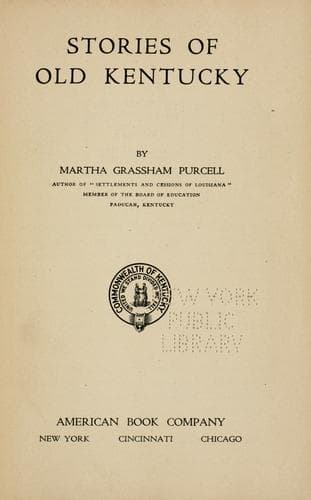
Stories of Old KentuckyPurcell, Martha C. Grassham, Mrs.
History
Stories of Old Kentucky
Purcell, Martha C. Grassham, Mrs.
Kentucky -- History
In Jefferson's "Notes on Virginia," he speaks of a tribe of Indians
called "Paducahs." In the "Handbook of American Indians" we find that
the "Paducahs" belonged to the warlike Comanches, this being the name
given them by the Spaniards. There is in Texas a small town of about one
thousand five hundred inhabitants, named Paducah from this tribe of
Indians.
Paducah, Kentucky, is named, not from the tribe, but from an individual
Indian. In his diary of the Lewis and Clark Expedition, General William
Clark speaks more than once of the kindness shown his party by a
scattered branch of the Paducahs, and of how their chief became his
friend. Dr. Catlin tells, in speaking of the tribes of the West, of a
chief of the Mandans, Indians that often intermarried with the
Comanches, named "Paducheyeh," meaning "tall or upstanding chestnut
tree." Whether or not he was the one who became the friend of General
Clark we do not know, but when the Comanches came southward, their old
chief, called Paducah, went to St. Louis, and then came with General
Clark on a visit to the town of Pekin, where he died with fever, and was
buried near Third Street just beyond Tennessee.
A log cabin was placed around his grave, and pioneer residents have told
of a party of Indians coming from beyond the Mississippi and holding
ceremonies over Paducah's grave. These were Comanches, or to use their
tribal name, Paducahs.
Whether the individual name of the old chief who had befriended General
Clark was one of the many varied spellings of Paducah, or whether
General Clark called him by his tribal name instead, we know not. Yet
there was a real chief in recognition of whose kindness the "Pride of
the Pennyrile" was named Paducah.
FOOTNOTE:
[3] For some of the facts in this chapter, the author is indebted to Mr.
Irvin S. Cobb.
LUCY JEFFERSON LEWIS
As travelers on the waters of "La Belle Rivière" pass between the
historic town of Smithland and the unpretentious hamlet of Birdsville,
few are aware that they are within a mile or two of the grave of a
younger sister of the writer of our Magna Charta.
Though Lucy Jefferson Lewis was the sister of the man to whom we owe our
American decimal coinage system, our statute for religious freedom, our
Declaration of Independence, the University of Virginia, and the
Democratic party; though she was the wife of Dr. Charles L. Lewis,
brother of the noted Meriwether Lewis; and though she was blessed with
wealth, culture, love, and family; yet to-day she sleeps in an unmarked
grave in Livingston County.
Filled with enthusiasm for the then far West, the Lewis family, in 1808,
ten years after Livingston County was formed, moved to Kentucky,
purchased a tract of land about three miles from Smithland, and on a
lonely, rocky hill overlooking the beautiful Ohio, raised their
rooftree, and with their Virginia slaves, began a home in the
wilderness.
Public-domain text, read in full here on John Shaqi.
Reviews
Reviews
No reviews yet
Be the first to share your thoughts on this work.
Elsewhere in the archive
Join the Discussion
Join the discussion
Sign in to leave a comment or review.
Sign InorCreate an account