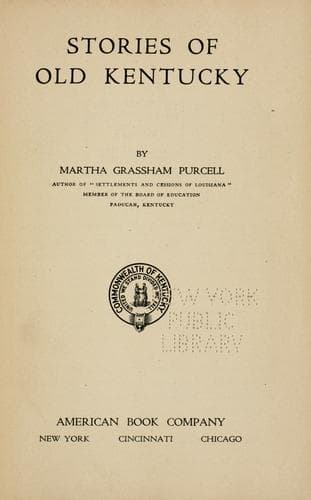
Stories of Old KentuckyPurcell, Martha C. Grassham, Mrs.
History
Stories of Old Kentucky
Purcell, Martha C. Grassham, Mrs.
Kentucky -- History
For several months, at various times and places, the Kentucky troops did
special and efficient service. In January of the succeeding year,
Colonel Lewis with from seven hundred to one thousand Kentuckians,
marched against a combined force of British and Indians at Frenchtown on
the river Raisin, and drove them from the village. Three days later,
General Winchester was told that a large force of the enemy was on its
way to attack the victors. As the night was bitter cold, the precaution
of stationing pickets was neglected, and early the next morning, two
thousand British and Indians under General Proctor suddenly attacked the
camp. The Kentucky riflemen fought stubbornly for hours. Their
ammunition ran low, but still they fought. Even when summoned to
surrender they, Spartanlike, preferred death. But, being promised that
their wounded would be safely guarded and humanely treated, they laid
down their arms. History records how this promise on the part of Proctor
was not kept, how the drunken Indians burned and tomahawked the helpless
men and officers, until long afterward the rallying cry of the
Kentuckians was, "Remember the river Raisin--Raisin and Revenge."
At Fort Stephenson, one hundred and sixty men under Colonel Croghan of
Kentucky repulsed Proctor with nearly four thousand. When the idolized
General Isaac Shelby went at the head of the Kentuckians, all felt that
he would lead them to victory.
It is said that when Commodore Perry wrote, "We have met the enemy and
they are ours," after his memorable victory on Lake Erie, that one
hundred sharpshooters from Kentucky had aided in the capture.
At the battle of the Thames nearly all the American troops were
Kentuckians, and that gallant soldier, Colonel Richard M. Johnson, did
noble service in the killing of the noted Tecumseh. When Jackson,
barricaded behind cotton bales at New Orleans, defeated Pakenham with
his veteran forces, more than one fifth of the American soldiers were
Kentucky riflemen.
A TRIUMVIRATE OF ELOQUENCE
Kentuckians, past and present, have ever been distinguished for their
brilliant, persuasive oratory on the stump, at the bar, or in the forum.
Three of the most eloquent men our state claimed in the nineteenth
century were Clay, Marshall, and Menefee.
[Illustration: Thomas F. Marshall.]
Wherever Thomas F. Marshall, a native of Kentucky, lifted up his voice,
he entranced all with his profound logic, flight of fancy, stinging
satire, and beauty of language. Had his powers of self-control been as
great as his genius, learning, and eloquence, no position in the dizzy
heights would have been beyond his reach. But his brilliancy, his worth,
and his work were all obscured by that dreadful blight, intemperance.
Mr. Marshall's tribute to another orator and statesman, Richard H.
Menefee, is pronounced by all to be one of the most graceful and
eloquent passages in our literature.
Public-domain text, read in full here on John Shaqi.
Reviews
Reviews
No reviews yet
Be the first to share your thoughts on this work.
Elsewhere in the archive
Join the Discussion
Join the discussion
Sign in to leave a comment or review.
Sign InorCreate an account