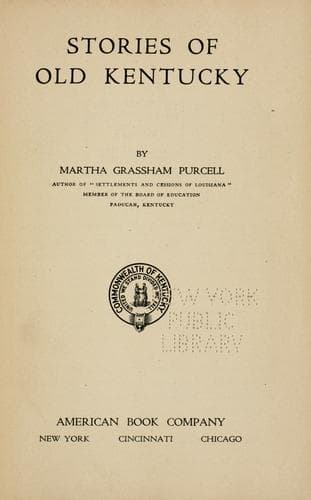
Stories of Old KentuckyPurcell, Martha C. Grassham, Mrs.
History
Stories of Old Kentucky
Purcell, Martha C. Grassham, Mrs.
Kentucky -- History
In the field of medical science, also, Kentucky in both past and
present has been noted. In 1806, Doctor Brashear of Bardstown
successfully performed an amputation at the hip joint, the first
operation of the kind in the United States. In 1809, Doctor Ephraim
McDowell of Danville performed one which was the first of its kind in
the world, and of which Doctor Gross in his "Lives of Eminent American
Physicians and Surgeons of the Nineteenth Century" says, "Had McDowell
lived in France, he would have been elected a member of the Royal
Academy of Surgery, received from the king the cross of the Legion of
Honor, and obtained from the government a magnificent reward as an
acknowledgment of the services rendered his country, his profession, and
his fellow creatures."
"BESSEMER STEEL" IN KENTUCKY
One most important invention or discovery of the nineteenth century was
made by William Kelly, who came from Pittsburgh and located near
Eddyville, in Lyon County, in 1846. Here he operated both the Union and
the Suwanee furnaces, mostly by slave labor, until he conceived the plan
of using Chinese workers, which he secured through a New York tea house.
As these Celestials, with their pigtails, were the first in this
section, they created a great deal of curiosity. Mr. Kelly, having a
special knowledge of chemistry and metallurgy, investigated and
experimented in the manufacture of iron, and concluded that the crude
metal could be converted into steel without fuel; that by placing the
fluid metal in a suitable furnace and forcing powerful blasts of air
through the molten mass, he could produce the desired result.
His veteran forgemen could not conceive of metal being "boiled" by
simply blowing air through it, for it had been their experience that air
blown over its surface chilled it. They knew nothing of the affinity of
oxygen with carbon for producing heat; they had always consumed
quantities of charcoal to secure this greater heat; they had buried bars
of wrought iron in charcoal in a furnace, where, the air being shut off,
the charcoal was slowly burned for two or more weeks. Then the product
was taken out and melted, forming "cast steel." So they were completely
surprised when forcing the currents of air through the mass of iron
intensified it to incandescence and refined the metal.
Public-domain text, read in full here on John Shaqi.
Reviews
Reviews
No reviews yet
Be the first to share your thoughts on this work.
Elsewhere in the archive
Join the Discussion
Join the discussion
Sign in to leave a comment or review.
Sign InorCreate an account