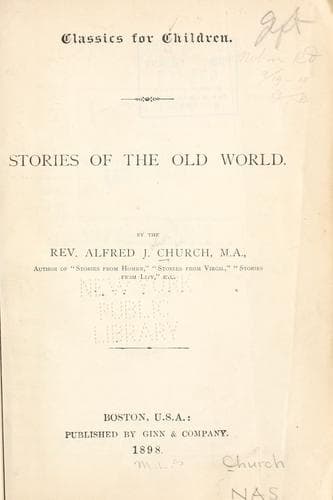
Mythology, Greek -- Juvenile literature; Mythology, Roman -- Juvenile literature
Then Achilles devised a ruthless thing in his heart. He pierced the
ankle-bones of Hector, and so bound the body with thongs of ox-hide to
the chariot, letting the head drag behind, the head that once was so
fair, and now was so disfigured in the dust. So he dragged Hector to
the ships. And Priam saw him from the walls, and scarce could his sons
keep him back, but that he should go forth and beg the body of his dear
son from him who had slain him. And Hecuba his mother also bewailed
him, but Andromaché knew not as yet of what had befallen. For she sat
in her dwelling, wearing a great purple mantle broidered with flowers.
And she bade her maidens make ready a bath for Hector, when he should
come back from the battle, nor knew that he should never need it more.
But the voice of wailing from the town came to her, and she rose up
hastily in great fear, and dropped the shuttle from her hand and called
to her maidens,--
“Come with me, ye maidens, that I may see what has befallen, for I
heard the voice of Queen Hecuba, and I fear me much that some evil has
come to the children of Priam. For it may be that Achilles has run
between Hector and the city, and is pursuing him to the plain, for
never will Hector abide with the army, but will fight in the front, so
bold is he.”
Then she hasted through the city like as she were mad. And when she
came to the wall she stood and looked; and lo! the horses of Achilles
were dragging Hector to the ships. Then did darkness come on her, and
she fell back fainting, and from her fair head dropped the net and the
wreath and the diadem which golden Aphrodité gave her on the day when
Hector of the waving plume took her from the house of Eëtion to be his
wife.
CHAPTER VI.
Although Hector, that was the chief stay of Troy was dead, yet could
not King Agamemnon take the city. And when it came to pass that
Achilles was slain, being smitten by Paris with an arrow (but some
say that Apollo slew him), then did he well-nigh despair. But the
soothsayers said, “Send, O King, for Philoctetes, and thou shalt have
thy desire.”
Public-domain text, read in full here on John Shaqi.
Reviews
Reviews
No reviews yet
Be the first to share your thoughts on this work.
Elsewhere in the archive
Join the Discussion
Join the discussion
Sign in to leave a comment or review.
Sign InorCreate an account