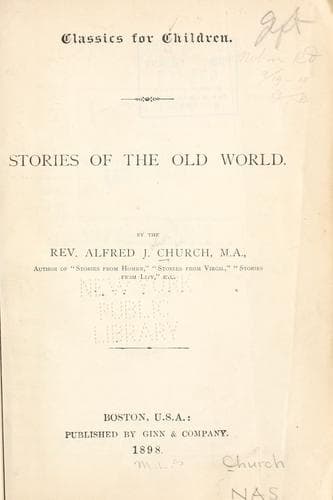
Mythology, Greek -- Juvenile literature; Mythology, Roman -- Juvenile literature
Then Ulysses made reply, “I can be all things as occasion serveth; such
as thou sayest, if need be; and yet no man more pious if the time call
for goodness and justice. One thing only I must needs do, and that is
to prevail. Yet here I will yield to thee. Thou wilt not go; so be it.
Loose him! We need thee not, having these arms of thine. Teucer is with
us, an archer not one whit less skilful than thou. And now I leave
thee to this Lemnos of thine. May be this bow shall bring me the honor
which thou refusest.”
When he had thus spoken he departed, and the Prince Neoptolemus with
him. Only the Prince gave permission to the sailors that they should
tarry with the sick man till it was time to make ready for the voyage.
Then Philoctetes bewailed himself, crying to his bow, “O my bow,
my beloved, that they have wrested from my hands, surely, if thou
knowest aught, thou grievest to see that the man who was the comrade
of Hercules will never hold thee more, but that base hands will grasp
thee, mixing thee with all manner of deceit.” And then again he called
to the birds of the air and the beasts of the field, that they should
not fly from him any more, seeing that he had now no help against
them, but should come and avenge themselves upon him and devour him.
And still the sailors would have comforted him. Also they sought to
persuade him that he should listen to the chiefs; but he would not,
crying that the lightning should smite him before he would go to Troy
and help them that had done him such wrong. And at the last he cried
that they should give him a spear or a sword, that he might be rid of
his life.
But while they thus talked together, the Prince came back like one that
is in haste, with Ulysses following him, who cried, “Wherefore turnest
thou back?”
“To undo what I did amiss.”
“How sayest thou? When didst thou thus?”
“When I listened to thee, and used deceit to a brave man.”
“What wilt thou then? (I fear me much what this fool may do.)”
“I will give back this bow and these arrows to him from whom I took
them by craft.”
“That shalt thou not do.”
“But who shall hinder me?”
“That will I, and all the sons of the Greeks with me.”
“This is idle talk for a wise man as thou art.”
“Seest thou this sword whereto I lay my hand?”
“If thou talkest of swords, thou shalt see right soon that I also have
a sword.”
“Well--I let thee alone. To the host will I tell this matter; they
shall judge thee.”
“Now thou speakest well; be ever as wise; so shalt thou keep thy foot
out of trouble.”
Then the Prince called to Philoctetes, who, being loosed by the
sailors, had hidden himself in the cave, and asked of him again whether
he were willing to sail with him, or were resolved to abide in the
island.
And when the man had denied that he would go, and had begun again to
call down a curse on the sons of Atreus, and on Ulysses, and on the
Prince himself, then the Prince bade him stay his speech, and gave him
back the bow and the arrows.
Public-domain text, read in full here on John Shaqi.
Reviews
Reviews
No reviews yet
Be the first to share your thoughts on this work.
Elsewhere in the archive
Join the Discussion
Join the discussion
Sign in to leave a comment or review.
Sign InorCreate an account