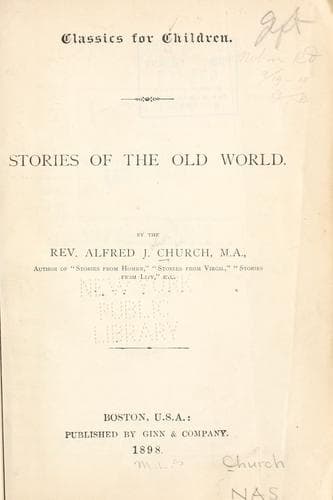
Mythology, Greek -- Juvenile literature; Mythology, Roman -- Juvenile literature
Then was Æneas severed from the rest, having with him two only, Iphitus
and Pelias, Iphitus being an old man and Pelias sorely wounded by
Ulysses. And these, hearing a great shouting, hastened to the palace
of King Priam, where the battle was fiercer than in any place beside.
For some of the Greeks were seeking to climb the walls, laying ladders
thereto, whereon they stood, holding forth their shields with their
left hands, and with their right grasping the roofs. And the men of
Troy, on the other hand, being in the last extremity, tore down the
battlements and the gilded beams wherewith the men of old had adorned
the palace. Then Æneas, knowing of a secret door whereby the unhappy
Andromaché in past days had been wont to enter, bringing her son
Astyanax to his grandfather, climbed on to the roof, and joined himself
to those that fought therefrom. Now upon this roof there was a tower,
whence all Troy could be seen and the camp of the Greeks and the ships.
This the men of Troy loosened from its foundations with bars of iron,
and thrust it over, so that it fell upon the enemy, slaying many of
them. But not the less did others press forward, casting the while
stones and javelins and all that came to their hands.
Meanwhile others sought to break down the gates of the palace, Pyrrhus,
son of Achilles, being foremost among them, clad in shining armor
of bronze. Like to a serpent was he, which sleeps indeed during the
winter, but in the spring comes forth into the light, full fed on evil
herbs, and, having cast his skin and renewed his youth, lifts his head
into the light of the sun and hisses with forked tongue. And with
Pyrrhus were tall Periphas, and Automedon, who had been armor-bearer to
his father Achilles, and following them the youth of Scyros, which was
the kingdom of his grandfather Lycomedes. With a great battle-axe he
hewed through the doors, breaking down also the door-posts, though they
were plated with bronze, making, as it were, a great window, through
which a man might see the palace within, the hall of King Priam and of
the kings who had reigned aforetime in Troy. But when they that were
within perceived it, there arose a great cry of women wailing aloud
and clinging to the doors and kissing them. But ever Pyrrhus pressed
on, fierce and strong as ever was his father Achilles, nor could aught
stand against him, either the doors or they that guarded them. Then, as
a river bursts its banks and overflows the plain, so did the sons of
Greece rush into the palace.
Public-domain text, read in full here on John Shaqi.
Reviews
Reviews
No reviews yet
Be the first to share your thoughts on this work.
Elsewhere in the archive
Join the Discussion
Join the discussion
Sign in to leave a comment or review.
Sign InorCreate an account