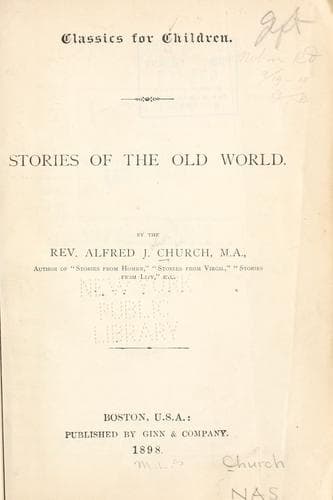
Mythology, Greek -- Juvenile literature; Mythology, Roman -- Juvenile literature
And after this they slept. And the next day the King called the chiefs
to an assembly, and told them of his purpose, that he would send this
stranger to his home, for that it was their wont to show such kindness
to such as needed it. And he bade fifty and two of the younger men make
ready a ship, and that the elders should come to his house, and bring
Demodocus, the minstrel, with them, for that he was minded to make a
great feast for this stranger before he departed. So the youths made
ready the ship. And afterwards there were gathered together a great
multitude, so that the palace was filled from the one end to the other.
And Alcinoüs slew for them twelve sheep and eight swine and two oxen.
And when they had feasted to the full, the minstrel sang to them of how
Achilles and Ulysses had striven together with fierce words at a feast,
and how King Agamemnon was glad, seeing that so the prophecy of Apollo
was fulfilled, saying that when valor and counsel should fall out, the
end of Troy should come. But when Ulysses heard the song, he wept,
holding his mantle before his face.
This Alcinoüs perceived, and said to the chiefs, “Now that we have
feasted and delighted ourselves with song, let us go forth, that this
stranger may see that we are skilful in boxing and wrestling and
running.”
So they went forth, a herald leading Demodocus by the hand, for the
minstrel was blind. Then stood up many Phæacian youths, and the fairest
and strongest of them all was Laodamas, eldest son to the King, and
after him Euryalus. And next they ran a race, and Clytoneus was the
swiftest. And among the wrestlers Euryalus was the best; and of the
boxers, Laodamas. And in throwing the quoit Elatrius excelled; and in
leaping at the bar, Amphialus.
Then Laodamas, Euryalus urging him, said to Ulysses, “Father, wilt
thou not try thy skill in some game, and put away the trouble from thy
heart?”
But Ulysses answered, “Why askest thou this? I think of my troubles
rather than of sport, and sit among you, caring only that I may see
again my home.”
Then said Euryalus, “And in very truth, stranger, thou hast not the
look of a wrestler or boxer. Rather would one judge thee to be some
trader, who sails over the sea for gain.”
“Nay,” answered Ulysses, “this is ill said. So true is it that the
gods give not all gifts to all men, beauty to one and sweet speech to
another. Fair of form art thou, no god could better thee; but thou
speakest idle words. I am not unskilled in these things, but stood
among the first in the old days; but since have I suffered much in
battle and shipwreck. Yet will I make trial of my strength, for thy
words have angered me.”
Whereupon he took a quoit, heavier far than such as the Phæacians were
wont to throw, and sent it with a whirl. It hurtled through the air, so
that the brave Phæacians crouched to the ground in fear, and fell far
beyond all the rest.
Public-domain text, read in full here on John Shaqi.
Reviews
Reviews
No reviews yet
Be the first to share your thoughts on this work.
Elsewhere in the archive
Join the Discussion
Join the discussion
Sign in to leave a comment or review.
Sign InorCreate an account