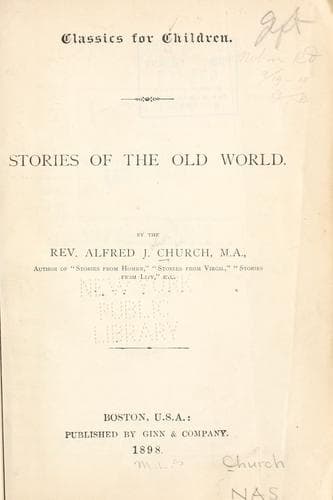
Mythology, Greek -- Juvenile literature; Mythology, Roman -- Juvenile literature
So he sang, and Ulysses wept to hear the tale. And when Alcinoüs
perceived that he wept, he bade Demodocus cease from his song, for
that some that were there liked it not. And to Ulysses he said that he
should tell them who was his father and his mother, and from what land
he came, and what was his name. All these things Ulysses told them, and
all that he had done and suffered, down to the time when the Princess
Nausicaa found him on the river shore. And when he had ended, King
Alcinoüs bade that the princes should give Ulysses yet other gifts; and
after that they went each man to his house to sleep.
The next day King Alcinoüs put all the gifts into the ship. And when
the evening was come, Ulysses bade farewell to the King and to the
Queen, and departed.
CHAPTER XI.
ULYSSES AND THE SWINEHERD.
Now Ulysses slept while the ship was sailing to Ithaca. And when it
was come to the shore he yet slept. Wherefore the men lifted him out,
and put him on the shore with all his goods that the princes of the
Phæacians had given him, and so left him. After a while he awoke, and
knew not the land, for there was a great mist about him, Athené having
contrived that it should be so, for good ends, as will be seen. Very
wroth was he with the men of Phæacia, thinking that they had cheated
him; nor did it comfort him when he counted his goods to find that of
these he had lost nothing.
But as he walked by the sea, lamenting his fate, Athené met him, having
the shape of a young shepherd, fair to look upon, such as are the sons
of kings; and Ulysses, when he saw him, was glad, and asked him how men
called the country wherein he was.
And the false shepherd said, “Thou art foolish, or, may be, hast come
from very far, not to know this country. Many men know it, both in the
east and in the west. Rocky it is, not fit for horses, nor is it very
broad; but it is fertile land, and full of wine; nor does it want for
rain, and a good pasture it is for oxen and goats; and men call it
Ithaca. Even in Troy, which is very far, they say, from this land of
Greece, men have heard of Ithaca.”
This Ulysses was right glad to hear. Yet he was not minded to say who
he was, but rather to feign a tale.
So he said, “Yes, of a truth, I heard of this Ithaca in Crete, from
which I am newly come with all this wealth, leaving also as much behind
for my children. For I slew Orsilochus, son of Idomeneus the king,
because he would have taken from me my spoil. Wherefore I slew him,
lying in wait for him by the way. Then made I covenant with certain
Phœnicians that they should take me to Pylos or to Elis; which thing
indeed they were minded to do, only the wind drave them hither, and
while I slept they put me upon the shore, and my possessions with me,
and departed to Sidon.”
This pleased Athené much, and she changed her shape, becoming like a
woman, tall and fair, and said to Ulysses,--
Public-domain text, read in full here on John Shaqi.
Reviews
Reviews
No reviews yet
Be the first to share your thoughts on this work.
Elsewhere in the archive
Join the Discussion
Join the discussion
Sign in to leave a comment or review.
Sign InorCreate an account