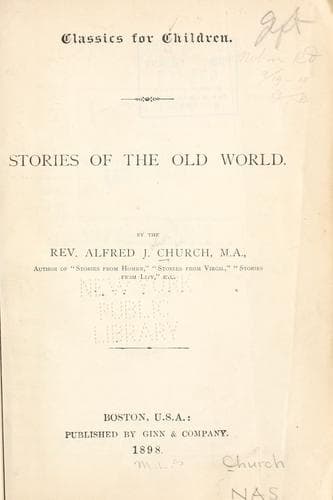
Mythology, Greek -- Juvenile literature; Mythology, Roman -- Juvenile literature
together, which King Pheidon was keeping till he himself should come
back from Dodona, from the oracle of Zeus. Thence I sailed in a ship
for Dulichium, purposing to go to King Acastus, but the sailors
were minded to sell me for a slave. Therefore they left me bound in
the ship, but themselves took their supper on the shore. But in the
meanwhile I brake my bonds, the gods helping me, and leaping into the
sea, swam to the land, and hid myself in a wood that was near.”
All this tale did Ulysses tell; but Eumæus doubted whether these things
were so, thinking rather that the beggar-man said these things to
please him. After this they talked much; and when the swineherd’s men
were returned, they all feasted together. And the night being cold, and
there being much rain, Ulysses was minded to see whether one would lend
him a cloak; wherefore he told this tale:--
“Once upon a time there was laid an ambush near to the city of Troy.
And Menelaüs and Ulysses and I were the leaders of it. In the reeds we
sat, and the night was cold, and the snow lay upon our shields. Now all
the others had cloaks, but I had left mine behind at the ships. So when
the night was three parts spent I spake to Ulysses, ‘Here am I without
a cloak; soon, methinks, shall I perish with the cold.’ Soon did he
bethink him of a remedy, for he was ever ready with counsel. Therefore
to me he said, ‘Hush, lest some one hear thee,’ and to the others, ‘I
have been warned in a dream. We are very far from the ships and in
peril. Wherefore let some one run to the ships to King Agamemnon, that
he send more men to help.’ Then Thoas, son of Andræmon, rose up and
ran, casting off his cloak, and this I took, and slept warmly therein.
Were I this night such as then I was, I should not lack such kindness
even now.”
Then said Eumæus, “This is well spoken, old man. Thou shalt have a
cloak to cover thee. But in the morning thou must put on thy own rags
again. Yet perchance, when the son of Ulysses shall come, he will give
thee new garments.”
After this they slept, but Eumæus tarried without, keeping watch over
the swine.
It came to pass the next morning that Telemachus, that was son of King
Ulysses, came to the dwelling of Eumæus, for he was newly returned from
Sparta, whither he had gone if haply he might hear some tidings of his
father.
And Ulysses heard the steps of a man, and, as the dogs barked not, said
to Eumæus, “Lo! there comes some comrade or friend, for the dogs bark
not.”
Public-domain text, read in full here on John Shaqi.
Reviews
Reviews
No reviews yet
Be the first to share your thoughts on this work.
Elsewhere in the archive
Join the Discussion
Join the discussion
Sign in to leave a comment or review.
Sign InorCreate an account