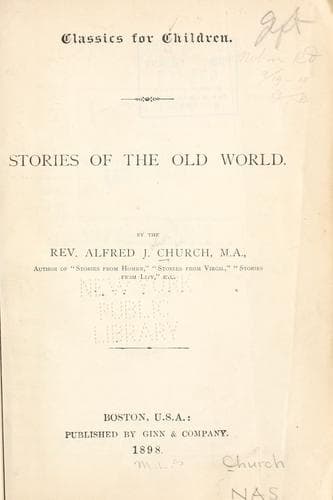
Mythology, Greek -- Juvenile literature; Mythology, Roman -- Juvenile literature
And as he spake he put a cloak of lion’s skin upon his shoulders, and
the old man sat thereon. Ascanius also laid hold of his hand, and
Creüsa followed behind. So he went in much dread and trembling. For
indeed before sword and spear of the enemy he had not feared, but now
he feared for them that were with him. But when he was come nigh unto
the gates, and the journey was well-nigh finished, there befell a
grievous mischance, for there was heard a sound as of many feet through
the darkness; and the old man cried to him, “Fly, my son, fly; they are
coming. I see the flashing of shields and swords.” But as Æneas hasted
to go, Creüsa his wife was severed from him. But whether she wandered
from the way or sat down in weariness, no man may say. Only he saw her
no more, nor knew her to be lost till, all his company being met at
the temple of Ceres, she only was found wanting. Very grievous did the
thing seem to him, nor did he cease to cry out in his wrath against
gods and men. Also he bade his comrades have a care of his father and
his son, and of the household gods, and girded him again with arms,
and so passed into the city. And first he went to the wall and to the
gate by which he had come forth, and then to his house, if haply she
had returned thither. But there indeed the men of Greece were come,
and the fire had well-nigh mastered it. And after that he went to the
citadel and to the palace of King Priam. And lo! in the porch of Juno’s
temple, Phœnix and Ulysses were keeping guard over the spoil, even the
treasure of the temples, tables of the gods, and solid cups of gold,
and raiment, and a long array of them that had been taken captive,
children and women. But not the less did he seek his wife through all
the streets of the city, yea, and called her aloud by name. But lo!
as he called, the image of her whom he sought seemed to stand before
him, only greater than she had been while she was yet alive. And the
spirit spake, saying, “Why art thou vainly troubled? These things have
not befallen us against the pleasure of the gods. The ruler of Olympus
willeth not that Creüsa should bear thee company in thy journey. For
thou hast a long journey to take, and many seas to cross, till thou
come to the Hesperian shore, where Lydian Tiber flows softly through a
good land and a fertile. There shalt thou have great prosperity, and
take to thyself a wife of royal race. Weep not then for Creüsa, whom
thou lovest, nor think that I shall be carried away to be a bond-slave
to some Grecian woman. Such fate befits not a daughter of Dardanus and
daughter-in-law of Venus. The mighty Mother of the gods keepeth me in
this land to serve her. And now, farewell, and love the young Ascanius,
even thy son and mine.”
Public-domain text, read in full here on John Shaqi.
Reviews
Reviews
No reviews yet
Be the first to share your thoughts on this work.
Elsewhere in the archive
Join the Discussion
Join the discussion
Sign in to leave a comment or review.
Sign InorCreate an account