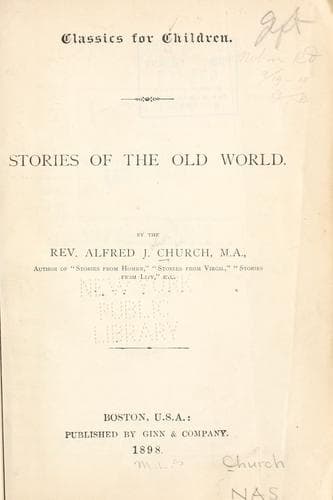
Mythology, Greek -- Juvenile literature; Mythology, Roman -- Juvenile literature
Then they set sail, and, the south wind blowing, passed by Zacynthus
and Dulichium, and also Ithaca, which they cursed as they passed,
because it was the land of the hateful Ulysses, and so came to Actium,
where they landed. There also they did sacrifice to the gods, and had
games of wrestling and others, rejoicing that they had passed safely
through so many cities of their enemies. And there they wintered, and
Æneas fixed on the doors of the temple of Apollo a shield of bronze
which he had won in battle from the valiant Abas, writing thereon these
words, “ÆNEAS DEDICATES THESE ARMS WON FROM THE VICTORIOUS GREEKS.”
But when the spring was come they set sail, and, leaving behind them
the land of Phæacia, came to Buthrotum that is in Epirus. There indeed
they heard a marvellous thing, even that Helenus, the son of Priam,
was king in these parts, in the room of Pyrrhus, the son of Achilles,
having also to wife Andromaché, who was the widow of Hector. And when
Æneas, wishing to know whether these things were so, journeyed towards
the city, lo! in a grove hard by, by a river which also was called
Simoïs, there stood this same Andromaché, and made offerings to the
spirit of Hector not without many tears. And at the first when she saw
Æneas, and that he wore such arms as the men of Troy were used to wear,
she swooned with fear, but after a while spake thus: “Is this indeed a
real thing that I see? Art thou alive? or, if thou art dead, tell me,
where is my Hector?” So she cried and wept aloud. And Æneas answered
her: “Yes, lady, this is flesh and blood, and not a spirit, that thou
seest. But as for thee, what fortune has befallen thee? Art thou still
wedded to Pyrrhus?”
And she, casting down her eyes, made answer, “O daughter of Priam,
happy beyond thy sisters in that thou wast slain at the tomb of
Achilles, nor wast taken to be a prey of the conqueror! But as for me I
was borne across the sea, to be slave to the haughty son of Achilles.
And when he took to wife Hermione, who was the daughter of Helen, he
gave me to Helenus, as a slave is given to a slave. But Pyrrhus, after
awhile, Orestes slew, taking him unawares, even by the altar of his
father. And when he was dead, part of his kingdom came to Helenus,
who hath called the land Chaonia, after Chaon of Troy, and hath also
builded a citadel, a new Pergama, upon the hills. But tell me, was it
some storm that drave thee hither, or chance, or, lastly, some sending
of the gods? And is Ascanius yet alive--the boy whom I remember? Doth
he yet think of his mother that is dead? And is he stout and of a good
courage, as befits the son of Æneas and sister’s son to Hector?”
Public-domain text, read in full here on John Shaqi.
Reviews
Reviews
No reviews yet
Be the first to share your thoughts on this work.
Elsewhere in the archive
Join the Discussion
Join the discussion
Sign in to leave a comment or review.
Sign InorCreate an account