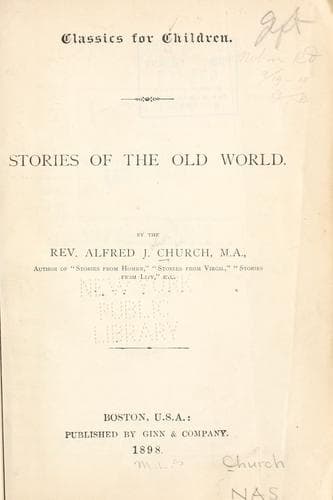
Mythology, Greek -- Juvenile literature; Mythology, Roman -- Juvenile literature
To whom answered King Æolus, “It is for thee, O Queen, to order what
thou wilt, it being of thy gift that I hold this sovereignty and eat at
the table of the gods.”
So saying he drave in with his spear the folding-doors of the prison
of the winds, and these straightway in a great host rushed forth,
even all the winds together, and rolled great waves upon the shore.
And straightway there arose a great shouting of men and straining of
cables; nor could the sky nor the light of the day be seen any more,
but a darkness as of night came down upon the sea, and there were
thunders and lightnings over the whole heavens.
Then did Æneas grow cold with fear; and stretching out his hands to
heaven, he cried, “Happy they who fell under the walls of Troy, before
their fathers’ eyes! Would to the gods that thou hadst slain me,
Diomed, bravest of the Greeks, even as Hector fell by the spear of
Achilles, or tall Sarpedon, or all the brave warriors whose dead bodies
Simoïs rolled down to the sea!”
But as he spake a blast of wind struck his sails from before, and
his ship was turned broad-side to the waves. Three others also were
tossed upon the rocks which men call the “Altars,” and three into the
quicksands of the Syrtis. And another, in which sailed the men of
Lycia, with Orontes, their chief, was struck upon the stern by a great
sea and sunk. And when Æneas looked, lo! there were some swimming in
the waves, and broken planks also, and arms and treasures of Troy.
Others also were shattered by the waves, and those of Ilioneüs and
Achates, and of Abas and the old man Alethes.
But King Neptune was aware of the tumult where he sat at the bottom of
the sea, and raising his head above the waves, looked forth and saw how
the ships were scattered abroad and the men of Troy were in sore peril.
Also he knew his sister’s wrath and her craft. Then he called to him
the winds and said, “What is this, ye winds, that ye trouble heaven and
earth without leave of me? Now will I--but I must first bid the waves
be still, only be sure that ye shall not thus escape hereafter. Begone,
and tell your King that the dominion over the sea belongeth unto me,
and bid him keep him to his rocks.”
Then he bade the waves be still; also he scattered the clouds and
brought back the sun. And Cymothea and Triton, gods of the sea, drew
the ships from the rocks, Neptune also lifting them with his trident.
Likewise he opened the quicksands, and delivered the ships that were
therein. And this being done he crossed the sea in his chariot, and
the waves beholding him sank to rest, even as it befalls when there is
sedition in the city, and the people are wroth, and men throw stones
and firebrands, till lo! of a sudden there cometh forth a reverend
sire, a good man and true, and all men are silent and hearken to him,
and the uproar is stayed. So was the sea stilled, beholding its King.
Public-domain text, read in full here on John Shaqi.
Reviews
Reviews
No reviews yet
Be the first to share your thoughts on this work.
Elsewhere in the archive
Join the Discussion
Join the discussion
Sign in to leave a comment or review.
Sign InorCreate an account