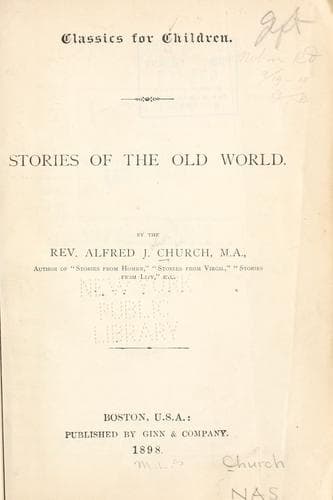
Mythology, Greek -- Juvenile literature; Mythology, Roman -- Juvenile literature
But while Æneas marvelled to see these things, lo! there came, with a
great throng of youths behind her, Dido, most beautiful of women, fair
as Diana, when, on the banks of Eurotas or on the hills of Cynthus, she
leads the dance with a thousand nymphs of the mountains about her. On
her shoulder she bears a quiver, and overtops them all, and her mother,
even Latona, silently rejoices to behold her. So fair and seemly to see
was Dido as she bare herself right nobly in the midst, being busy in
the work of her kingdom. Then she sat herself down on a lofty throne
in the gate of the temple, with many armed men about her. And she did
justice between man and man; also she divided the work of the city,
sharing it equally or parting it by lot.
Then of a sudden Æneas heard a great clamor, and saw a company of men
come quickly to the place, among whom were Antheus and Sergestus and
Cloanthus, and others of the men of Troy that had been parted from him
in the storm. Right glad was he to behold them, yet was not without
fear; and though he would fain have come forth and caught them by the
hand, yet did he tarry, waiting to hear how the men had fared, where
they had left their ships, and wherefore they were come.
Then Ilioneus, leave being now given that he should speak, thus began:
“O Queen, whom Jupiter permits to build a new city in these lands, we
men of Troy, whom the winds have carried over many seas, pray thee
that thou save our ships from fire, and spare a people that serveth
the gods. For, indeed, we are not come to waste the dwellings of this
land, or to carry off the spoils to our ships. For, of a truth, they
who have suffered so much think not of such deeds. There is a land
which the Greeks call Hesperia, but the people themselves Italy, after
the name of their chief; an ancient land, mighty in arms and fertile
of corn. Hither were we journeying, when a storm arising scattered our
ships, and only these few that thou seest escaped to the land. And can
there be nation so savage that it receiveth not shipwrecked men on its
shore, but beareth arms against them, and forbiddeth them to land? Nay,
but if ye care not for men, yet regard the gods, who forget neither
them that do righteously nor them that transgress. We had a king,
Æneas, than whom there lived not a man more dutiful to gods and men and
greater in war. If indeed he be yet alive, then we fear not at all. For
of a truth it will not repent thee to have helped us. And if not, other
friends have we, as Acestes of Sicily. Grant us, therefore, to shelter
our ships from the wind: also to fit them with fresh timber from the
woods, and to make ready oars for rowing, so that, finding again our
King and our companions, we may gain the land of Italy. But if he be
dead, and Ascanius his son lost also, then there is a dwelling ready
for us in the land of Sicily, with Acestes, who is our friend.”
Public-domain text, read in full here on John Shaqi.
Reviews
Reviews
No reviews yet
Be the first to share your thoughts on this work.
Elsewhere in the archive
Join the Discussion
Join the discussion
Sign in to leave a comment or review.
Sign InorCreate an account