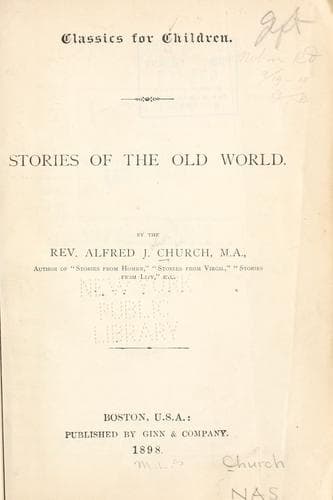
Mythology, Greek -- Juvenile literature; Mythology, Roman -- Juvenile literature
Then did Love as his mother bade him, and put off his wings, and took
upon him the shape of Ascanius, but on the boy Venus caused there to
fall a deep sleep, and carried him to the woods of Idalium, and lapped
him in sweet-smelling flowers. And in his stead Love carried the gifts
to the Queen. And when he was come they sat down to the feast, the
Queen being in the midst under a canopy. Æneas also and the men of
Troy lay on coverlets of purple, to whom serving-men brought water
and bread in baskets and napkins; and within fifty handmaids were
ready to replenish the store of victual and to fan the fire; and a
hundred others, with pages as many, loaded the tables with dishes and
drinking-cups. Many men of Tyre also were bidden to the feast. Much
they marvelled at the gifts of Æneas, and much at the false Ascanius.
Dido also could not satisfy herself with looking on him, nor knew what
trouble he was preparing for her in the time to come. And he, having
first embraced the father who was not his father, and clung about his
neck, addressed himself to Queen Dido, and she ever followed him with
her eyes, and sometimes would hold him on her lap. And still he worked
upon her that she should forget the dead Sichæus and conceive a new
love in her heart.
But when they first paused from the feast, lo! men set great bowls upon
the table and filled them to the brim with wine. Then did the Queen
call for a great vessel of gold, with many jewels upon it, from which
Belus, and all the kings from Belus, had drunk, and called for wine,
and having filled it, she cried, “O Jupiter, whom they call the god of
hosts and guests, cause that this be a day of joy for the men of Troy
and for them of Tyre, and that our children remember it forever. Also,
Bacchus, giver of joy, be present, and kindly Juno.” And when she had
touched the wine with her lips, she handed the great cup to Prince
Bitias, who drank thereout a mighty draught, and the other princes
after him. Then the minstrel Iopas, whom Atlas himself had taught,
sang to the harp, of the moon, how she goes on her way, and of the
sun, how his light is darkened. He sang also of men, and of the beasts
of the field, whence they come; and of the stars, Arcturus, and the
Greater Bear and the Less, and the Hyades; and of the winter sun, why
he hastens to dip himself in the ocean; and of the winter nights, why
they tarry so long. The Queen also talked much of the story of Troy, of
Priam, and of Hector, asking many things, as of the arms of Memnon, and
of the horses of Diomed, and of Achilles, how great he was. And at last
she said to Æneas, “Tell us now thy story, how Troy was taken, and thy
wanderings over land and sea.” And Æneas made answer, “Nay, O Queen,
but thou biddest me renew a sorrow unspeakable. Yet, if thou art minded
to hear these things, hearken.” And he told her all that had befallen
him, even to the day when his father Anchises died.
Public-domain text, read in full here on John Shaqi.
Reviews
Reviews
No reviews yet
Be the first to share your thoughts on this work.
Elsewhere in the archive
Join the Discussion
Join the discussion
Sign in to leave a comment or review.
Sign InorCreate an account