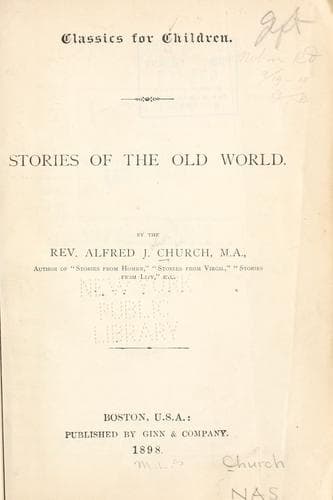
Mythology, Greek -- Juvenile literature; Mythology, Roman -- Juvenile literature
The place whereunto he came was nigh unto Cumæ, which was the
dwelling-place of the Sibyl. And the men turned the forepart of the
ships to the sea, and made them fast with anchors. Then they leapt
forth upon the shore, and kindled a fire; and some cut wood in the
forest, or fetched water from the stream. But Æneas went up to the
great cave of the Sibyl, where, by the inspiration of Apollo, she
foretelleth things to come.
Now the temple was a marvellous place to look upon. For Dædalus,
when he fled from Minos, King of Crete, flying through the air upon
wings, came northwards to the land of Cumæ, and tarried there. Also he
dedicated his wings in the temple. On the doors thereof was set forth,
graven in stone, the death of Androgeos, and the men of Attica choosing
by lot seven of their children who should be given as a ransom yearly;
and, rising from the sea upon the other side, the land of Crete.
Likewise the Labyrinth was there and its winding ways; but Icarus they
saw not, for when his father would have wrought the manner of his death
in gold his hands failed him: twice he strove and twice they failed.
And when Æneas would have looked further, the priestess said, “Linger
not with these things, but slay forthwith seven bullocks from the herd,
and seven sheep duly chosen out of the flock.” And when they came to
the cave--now there are a hundred doors, and a voice cometh forth from
each--the Sibyl cried, “It is time. Lo! the god, the god!” And even
as she spake her look was changed and the color of her face; also her
hair was loosened, and her breast panted, and she waxed greater than is
the stature of a man. Then she cried, “Delayest thou to pray, Æneas of
Troy? delayest thou? for the doors open not but to prayer.” Nor said
she more. Then Æneas prayed, saying, “O Phœbus, who didst always pity
the sorrows of Troy, and didst guide the arrow of Paris that it slew
the great Achilles, I have followed thy bidding, journeying over many
lands, and now I lay hold on this shore of Italy, which ever seemed to
fly before me. Grant thou that our ill fortune follow us no more. And
all ye gods and goddesses who loved not Troy, be merciful to us. And
thou, O Prophetess, give, if it may be, such answer as I would hear.
So will I and my people honor thee for ever. And write it not, I pray
thee, upon leaves, lest the winds carry them away, but speak with thy
voice.”
Public-domain text, read in full here on John Shaqi.
Reviews
Reviews
No reviews yet
Be the first to share your thoughts on this work.
Elsewhere in the archive
Join the Discussion
Join the discussion
Sign in to leave a comment or review.
Sign InorCreate an account