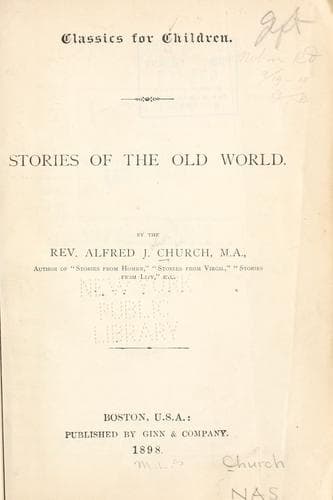
Mythology, Greek -- Juvenile literature; Mythology, Roman -- Juvenile literature
Of this country Latinus was king, who was the son of Faunus, who was
the son of Picus, who was the son of Saturn. And King Latinus had not a
son, but a daughter only, Lavinia by name, who was now of an age to be
married. Many chiefs of Latium, and of all Italy, desired to have her
to wife; of whom the first was Turnus, a very comely youth, and of a
royal house. Now the Queen, the mother of the virgin, loved him, and
would fain have married her daughter to him, but the gods hindered the
marriage with ill omens and marvels. In the midst of the palace was a
great bay-tree, which the King who had builded the house had dedicated
to Phœbus. On this there lighted a great swarm of bees, and hung like
unto a cluster of grapes from a bough thereof. And the seers, beholding
the thing, cried, “There cometh a stranger who shall be husband to
Lavinia, and a strange people who shall bear rule in this place.” Also
when Lavinia lighted the fire upon the altar, standing by her father,
a flame leapt therefrom upon her hair, and burned the ornament that
was upon her head and the crown of jewels and gold, and spread with
smoke and fire over the whole palace. Whereupon the prophets spake,
saying, “The virgin indeed shall be famous and great, but there cometh
a dreadful war upon her people.” And King Latinus, fearing what these
things might mean, inquired of the oracle of Faunus, his father, which
is by the grove of Albunea. Now the custom is that the priest offereth
sacrifice in the grove and lieth down to sleep on the skins of the
sheep that he hath slain; and it cometh to pass that he seeth visions
in the night and heareth the voice of the gods. So King Latinus, being
himself a priest, made a great sacrifice, even of a hundred sheep, and
lay down to sleep upon the skins thereof. And when he was laid down,
straightway there came a voice from the grove, saying, “Seek not, my
son, to marry thy daughter to a chief of this land. There shall come a
son-in-law from beyond the sea, who shall exalt our name from the one
end of heaven to the other.” Nor did the King hide these things, but
noised them abroad, and the fame thereof was great in these days when
Æneas and his company came to the land of Italy.
Public-domain text, read in full here on John Shaqi.
Reviews
Reviews
No reviews yet
Be the first to share your thoughts on this work.
Elsewhere in the archive
Join the Discussion
Join the discussion
Sign in to leave a comment or review.
Sign InorCreate an account