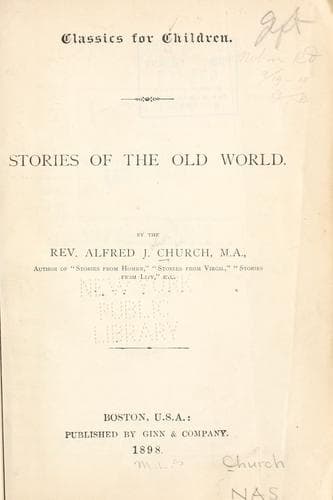
Mythology, Greek -- Juvenile literature; Mythology, Roman -- Juvenile literature
And now tidings came to Æneas that it fared ill with his men, and that
Pallas was slain. Across the field he sped, and all his heart was full
of wrath against Turnus and pity for the old man Evander; and first
he took alive eight youths, whom he should slay upon the tomb. Then
he cast his spear at Lagus; but Lagus avoided it by craft, and rushed
forward, and caught him by the knees, beseeching him by the spirit of
his father and the hopes of Iülus that he would spare him, and take a
ransom for his life. But Æneas made answer, “Talk not of sparing nor
of ransom; for to all courtesy of war there is an end now that Turnus
hath slain Pallas.” And he caught the man’s helmet with his left hand,
and, bending back his neck, thrust in the sword up to the hilt. And
many other valiant chiefs he slew, as Hæmonides, priest of Phœbus and
Diana, and Tarquitus, son of Faunus, and dark Camers, son of Volscens.
And now there met him two brethren on one chariot, Lucagus and Liger.
And Liger, who indeed drave the horses, cried aloud, “These are not the
horses of Diomed, nor this the chariot of Achilles, from which thou
mayest escape. Lo! the end of thy battles and thy life is come.” But
Æneas spake not, but cast his spear, and even as Lucagus made himself
ready for battle, it sped through his shield and pierced his thigh.
Then he fell dying on the plain. And Æneas cried, mocking him, “Thy
horses are not slow to flee, nor frightened by a shadow. Of thine own
will thou leavest thy chariot.” And he caught the horses by the head.
Then Liger stretched out his hands to him in supplication, saying,
“I beseech thee, by thy parents, have pity upon me.” But Æneas made
answer, “Nay, but thou speakest not thus before. Die! and desert not
thy brother.” And he thrust the sword into his breast. Thus did Æneas
deal death through the host, even as he had been the giant Typhœus with
the hundred hands. And when Iülus and the men of Troy beheld him they
brake forth from the camp.
And now Juno bethought her how she might save Turnus, whom she loved.
So she caused that there should pass before his eyes an image as of
Æneas, which seemed to defy him to battle. And when Turnus would have
fought, lo! the false Æneas fled, and Turnus followed him. Now there
chanced to be lying moored to a great rock a certain ship, on which
King Asinius had come from Clusium. Into this the false Æneas fled,
and Turnus followed hard upon him, but found not the man. And when he
looked, Juno had burst the moorings of the ship, and the sea was about
him on every side. Then he cried, “What have I done, great Jupiter,
that I should suffer such shame? What think the Latins of my flight?
Drown me, ye winds and waves, or drive me where no man may see me
more.” Thrice he would have cast himself into the sea; thrice would he
have slain himself with the sword; but Juno forbade, and brought him
safe to the city of Daunus, his father.
Public-domain text, read in full here on John Shaqi.
Reviews
Reviews
No reviews yet
Be the first to share your thoughts on this work.
Elsewhere in the archive
Join the Discussion
Join the discussion
Sign in to leave a comment or review.
Sign InorCreate an account