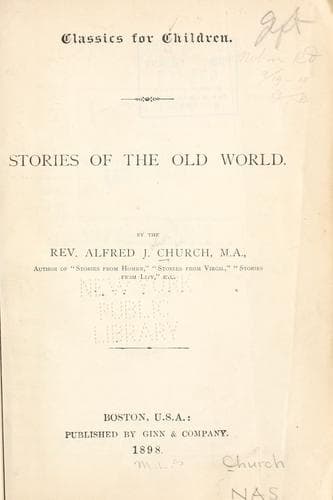
Mythology, Greek -- Juvenile literature; Mythology, Roman -- Juvenile literature
So the battle had an end. And the next day, early in the morning, Æneas
paid his vows. For he took an oak-tree, and lopped the branches round
about, and set it on a mound. And thereon he hung, for a trophy to
Mars, the arms of King Mezentius, the crest dripping with blood, and
the headless spears, and the corselet pierced in twelve places. Also
he fastened on the left hand the shield, and hung about the neck the
ivory-hilted sword. And next, the chiefs being gathered about him, he
spake, saying, “We have wrought a great deed. Here ye see all that
remaineth of Mezentius. Now, therefore, let us make ready to carry the
war against the city of Latinus. This therefore will we do with the
first light to-morrow. And now let us bury the dead, doing such honor
to them as we may, for indeed they have purchased a country for us
with their own blood. But first will I send back Pallas to the city of
Evander.”
Then he went to the tent where the dead body was laid, and old Acœtes
kept watch thereby--Acœetes, who had been armor-bearer to Evander, and
now had followed his son, but with evil fortune; and the women of Troy,
with their hair unbound, mourned about him. But when they saw Æneas
they beat their breasts, and sent up a great cry even to heaven. And
when the King saw the pillowed head, and the great wound in the breast,
he wept, and said, “Ah! why did Fortune grudge me this, that thou
shouldst see my kingdom, and go back in triumph to thy father’s home?
This is not what I promised to Evander when he gave thee to my charge,
and warned me that the men of Italy were valiant and fierce. And now
haply, old man, thou makest offerings and prayers for him who oweth
not service any more to the gods of heaven. Yet, at least, thou wilt
see that he beareth an honorable wound. But what a son thou losest, O
Italy! and what a friend, thou, Iülus!”
Then he choose a thousand men who should go with the dead and share the
father’s grief. After this they made a bier of arbutus boughs and oak,
and put also over it a canopy of branches, and laid the dead thereon,
like unto a flower of violet or hyacinth which a girl hath plucked,
which still hath beauty and color, but the earth nourisheth it no more.
And Æneas took two robes of purple, which Dido had woven with thread of
gold, and with one he wrapped the body and with the other the head. And
behind were carried the arms which Pallas had won in fight; and they
led the old man Acœtes, smiting on his breast and tearing his cheeks,
and throwing himself upon the ground; and the war-horse Æthon walked
beside, with the great tears rolling down his cheeks. And also they
bare behind him his helmet and shield, for all else Turnus had taken:
and then followed the whole company, the men of Troy, the Arcadians,
and the Tuscans, with arms reversed. And Æneas said, “The same cares
and sorrows of war call me elsewhere. Farewell, my Pallas, for ever!”
And he departed to the camp.
Public-domain text, read in full here on John Shaqi.
Reviews
Reviews
No reviews yet
Be the first to share your thoughts on this work.
Elsewhere in the archive
Join the Discussion
Join the discussion
Sign in to leave a comment or review.
Sign InorCreate an account