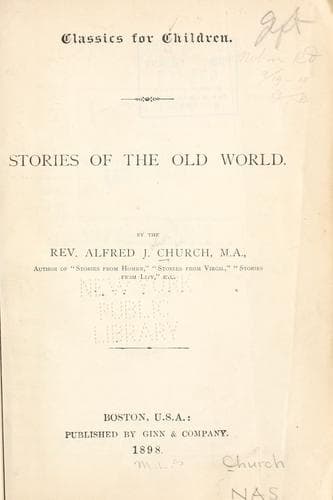
Mythology, Greek -- Juvenile literature; Mythology, Roman -- Juvenile literature
Then Amata cried to him, saying, “Fight not, I beseech thee, with
these men of Troy, my son; for surely what thou sufferest I also shall
suffer. Nor will I live to see Æneas my son-in-law.”
And Lavinia heard the voice of her mother, and wept. As a man stains
ivory with crimson, or as roses are seen mixed with lilies, even so the
virgin’s face burned with crimson. And Turnus, regarding her, loved her
exceedingly, and made answer: “Trouble me not with tears or idle words,
my mother, for to this battle I must go. And do thou, Idmon the herald,
say to the Phrygian king, ‘To-morrow, when the sun shall rise, let the
people have peace, but we two will fight together. And let him that
prevaileth have Lavinia to wife.’”
Then first he went to the stalls of his horses. The wife of the North
Wind gave them to Pilumnus. Whiter than snow were they, and swifter
than the wind. Then he put the coat of mail about his shoulders, and
fitted a helmet on his head, and took the great sword which Vulcan had
made for Daunus his father, and had dipped it when it was white-hot
in the river of Styx. His spear also he took where it stood against
a pillar, saying, “Serve me well, my spear, that has never failed me
before, that I may lay low this womanish robber of Phrygia, and soil
with dust his curled and perfumed hair.”
The next day the men of Italy and the men of Troy measured out a space
for the battle. And in the midst they builded an altar of turf. And the
two armies sat on the one side and on the other, having fixed their
spears in the earth and laid down their shields. Also the women and the
old men stood on the towers and roofs of the city, that they might see
the fight.
But Queen Juno spake to Juturna, the sister of Turnus, saying, “Seest
thou how these two are now about to fight, face to face? And indeed
Turnus goeth to his death. As for me, I endure not to look upon this
covenant or this battle. But if thou canst do aught for thy brother,
lo! the time is at hand.” And when the Nymph wept and beat her breast,
Juno said, “This is no time for tears. Save thy brother, if thou canst,
from death; or cause that they break this covenant.”
Public-domain text, read in full here on John Shaqi.
Reviews
Reviews
No reviews yet
Be the first to share your thoughts on this work.
Elsewhere in the archive
Join the Discussion
Join the discussion
Sign in to leave a comment or review.
Sign InorCreate an account