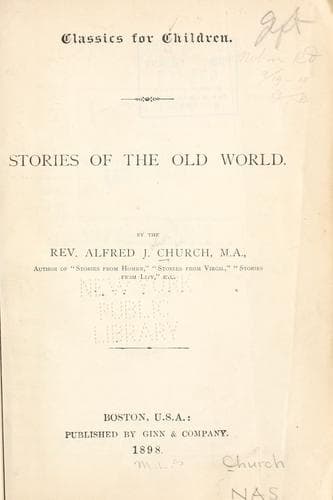
Mythology, Greek -- Juvenile literature; Mythology, Roman -- Juvenile literature
But it was not the will of the gods that the sons of Troy should
do this thing, but rather that their city should perish. So Athené
took upon herself the shape of Laodocus, son of Antenor, and went
to Pandarus, son of Lycaon, where he stood among his men. Then the
false Laodocus said, “Pandarus, darest thou aim an arrow at Menelaüs?
Truly the Trojans would love thee well, and Paris best of all, if
they could see Menelaüs slain by an arrow from thy bow. Aim then, but
first pray to Apollo, and vow that thou wilt offer a hundred beasts
when thou returnest to thy city, Zeleia.” Now Pandarus had a bow made
of the horns of a wild goat which he had slain; sixteen palms long
they were, and a cunning workman had made them smooth, and put a tip
of gold whereon to fasten the bowstring. And Pandarus strung his bow,
his comrades hiding him with their shields. Then he took an arrow from
his quiver, and laid it on the bow-string, and drew the string to his
breast, till the arrow-head touched the bow, and let fly. Right well
aimed was the dart, but it was not the will of heaven that it should
slay Menelaüs. It struck him, indeed, and passed through the belt and
through the corselet and through the girdle, and pierced the skin.
Then the red blood rushed out and stained the white skin, even as some
Lycian or Carian woman stains the white ivory with red to adorn the
war-horse of a king.
Sore dismayed was King Agamemnon to see the blood; sore dismayed also
was the brave Menelaüs till he spied the barb of the arrow, and knew
that the wound was not deep. But Agamemnon cried,--
“It was in an evil hour for thee, my brother, that I made a covenant
with these false sons of Troy. Right well, indeed, I know that oath
and sacrifice are not in vain, but will have vengeance at the last.
Troy shall fall; but woe is me if thou shouldst die, Menelaüs. For
the Greeks will straight go back to their fatherland, and the fair
Helen will be left a boast to the sons of Troy, and I shall have great
shame when one of them shall say, as he leaps on the tomb of the brave
Menelaüs, ‘Surely the great Agamemnon has avenged himself well; for
he brought an army hither, but now is gone back to his home, but left
Menelaüs here.’ May the earth swallow me up before that day!”
“Nay,” said Menelaüs, “fear not, for the arrow has but grazed the skin.”
Then King Agamemnon bade fetch the physician. So the herald fetched
Machaon, the physician. And Machaon came, and drew forth the arrow, and
when he had wiped away the blood he put healing drugs upon the wound,
which Chiron, the wise healer, had given to his father.
CHAPTER II.
Public-domain text, read in full here on John Shaqi.
Reviews
Reviews
No reviews yet
Be the first to share your thoughts on this work.
Join the Discussion
Join the discussion
Sign in to leave a comment or review.
Sign InorCreate an account