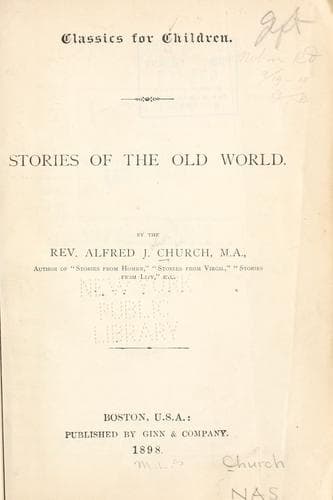
Mythology, Greek -- Juvenile literature; Mythology, Roman -- Juvenile literature
But while this was doing, King Agamemnon went throughout the host,
and if he saw anyone stirring himself to get ready for the battle he
praised him and gave him good encouragement; but whomsoever he saw
halting and lingering and slothful, him he blamed and rebuked whether
he were common man or chief. The last that he came to was Diomed, son
of Tydeus, with Sthenelus, son of Capaneus, standing by his side. And
Agamemnon spake, “How is this, son of Tydeus? Shrinkest thou from the
battle? This was not thy father’s wont. I never saw him indeed, but
I have heard that he was braver than all other men. Once he came to
Mycenæ with great Polynices to gather allies against Thebes. And the
men of Mycenæ would have sent them, only Zeus showed evil signs from
heaven and forbade them. Then the Greeks sent Tydeus on an embassy
to Thebes, where he found many of the sons of Cadmus feasting in the
palace of Eteocles; but Tydeus was not afraid, though he was but one
among many. He challenged them to contend with him in sport, and in
everything he prevailed. But the sons of Cadmus bare it ill, and
they laid an ambush for Tydeus as he went back, fifty men with two
leaders--Mæon and Lycophon. But Tydeus slew them all, leaving only
Mæon alive, that he might carry back the tidings to Thebes. Such was
thy father; but his son is worse in battle, but better, it may be, in
speech.”
Nothing said Diomed, for he reverenced the king; but Sthenelus cried
out, “Why speakest thou false, King Agamemnon, knowing the truth? We
are not worse but better than our fathers. Did not we take Thebes,
though we had fewer men than they, who indeed took it not?” But Diomed
frowned and said, “Be silent, friend. I blame not King Agamemnon that
he rouses the Greeks to battle. Great glory will it be to him if they
take the city, and great loss if they be worsted. But it is for us to
be valiant.”
So he passed through all the host. And the Greeks went forward to the
battle, as the waves that curl themselves and then dash upon the shore,
throwing high the foam. In order they went after their chiefs; you had
thought them dumb, so silent were they. But the Trojans were like a
flock of ewes which wait to be milked, and bleat hearing the voice of
their lambs, so confused a cry went out from their army, for there
were men of many tongues gathered together. And on either side the gods
urged them on, but chiefly Athené the Greeks, and Ares the sons of
Troy. Then, as two streams in flood meet in some chasm, so the armies
dashed together, shield on shield and spear on spear.
Public-domain text, read in full here on John Shaqi.
Reviews
Reviews
No reviews yet
Be the first to share your thoughts on this work.
Join the Discussion
Join the discussion
Sign in to leave a comment or review.
Sign InorCreate an account