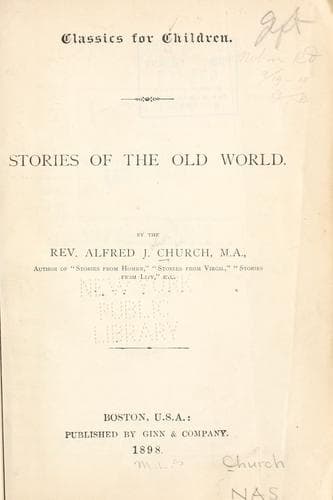
Mythology, Greek -- Juvenile literature; Mythology, Roman -- Juvenile literature
Then said Nestor, “But what cares Achilles for the Greeks? or why does
he ask who are wounded? But, O Patroclus, dost thou mind the day when
I and Ulysses came to the house of Peleus, and how thy father Menætius
was there, and how we feasted in the hall; and when the feast was
finished told our errand, for we were gathering the heroes for the war
against the sons of Troy? Right willing were ye two to come, and many
counsels did the old men give you. Then to Achilles Peleus said that he
should always be foremost in the host, but to thee thy father Menætius
spake, ‘Achilles is nobler born than thou, and stronger far; but thou
art older. Do thou therefore counsel him well, when there is need.’ But
this thou forgettest, Patroclus. Hear, then, what I say. It may be that
Achilles will not go forth to the battle. But let him send thee forth,
and the Myrmidons with thee, and let him put his arms upon thee, so
that the sons of Troy be affrighted, thinking that he is in the battle,
and we shall have breathing space.”
Then Patroclus turned to run to Achilles, but as he ran he met
Eurypylus, who spake to him,--
“Small hope is there now for the Greeks, seeing that all their bravest
chiefs lie wounded at the ships. But do thou help me, for thou knowest
all the secrets of healing, seeing that the wise Chiron himself taught
thee.”
Then Patroclus answered, “I am even now on my way to tell these things
to Achilles, but thee I may not leave in thy trouble.”
So he took him to his tent, and cut out the arrow from his thigh,
washing the wound with water, and putting on it a bitter healing root,
so that the pain was stayed and the blood stanched.
Now by this time the Trojans were close upon the trench. But the horses
stood on the brink, fearing to leap it, for it was broad and deep, and
the Greeks had put great stakes therein. Thus said Polydamas,--
“Surely, Hector, this is madness that we strive to cross the trench
in our chariots, for it is broad and deep, and there are great stakes
therein. Look, too, at this: even if we should be able to cross it, how
will the matter stand? If indeed it be the pleasure of Zeus that the
Greeks should perish utterly,--it will be well. But if they turn upon
us and pursue us, driving us back from the ships, then shall we not
be able to return. Wherefore let us leave our chariots here upon the
brink, and go on foot against the wall.”
Public-domain text, read in full here on John Shaqi.
Reviews
Reviews
No reviews yet
Be the first to share your thoughts on this work.
Elsewhere in the archive
Join the Discussion
Join the discussion
Sign in to leave a comment or review.
Sign InorCreate an account