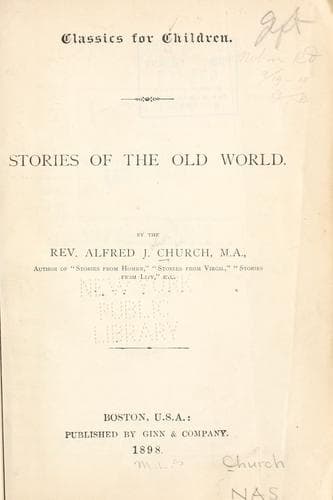
Mythology, Greek -- Juvenile literature; Mythology, Roman -- Juvenile literature
Now Poseidon was watching the battle from the wooded height of
Samothrace, whence he could see Ida and Troy and the ships. And he
pitied the Greeks when he saw how they fled before Hector, and purposed
in his heart to help them. So he left the height of Samothrace, and
came with four strides to Ægæ, where his palace was in the depths of
the sea. There he harnessed the horses to his chariot and rode, passing
over the waves, and the great beasts of the sea gambolled about him
as he went, knowing their king. But when he came to the camp of the
Greeks, he took upon him the shape of Calchas, the herald, and went
through the host strengthening the heroes for the battle--Ajax the
Greater, and Ajax the Less, and others also--so that they turned their
faces again to the enemy. But not the less did the men of Troy press
on, Hector leading the way.
Then first of all Teucer slew a Trojan, Imbrius by name, wounding him
under the ear. He fell as some tall poplar falls which a woodman fells
with axe of bronze. Then Teucer rushed to seize his arms, but Hector
cast his spear. Teucer it struck not, missing him by a little, but
Amphimachus it smote on the breast so that he fell dead. Then Hector
seized the dead man’s helmet, seeking to drag the body among the sons
of Troy. But Ajax stretched forth his great spear against him, and
struck the boss of his shield mightily, driving him backwards, so that
he loosed hold of the helmet of Amphimachus. And him his comrades bore
to the rear of the host, and the body of Imbrius also they carried off.
Then did Idomeneus the Cretan, son of Minos, the wise judge, perform
many valiant deeds, going to the left-hand of the battle-line, for he
said,--
“The Greeks have stay enough where the great Ajax is. No man that eats
bread is better than he; no, not Achilles’ self, were the two to stand
man to man, but Achilles indeed is swifter of foot.”
And first of all he slew Othryoneus, who had but newly come, hearing
the fame of the war. For Cassandra’s sake he had come, that he might
have her to wife, vowing that he would drive the Greeks from Troy, and
Priam had promised him the maiden. But now Idomeneus slew him, and
cried over him,--
“This was a great thing that thou didst promise to Priam, for which
he was to give thee his daughter. Thou shouldst have come to us, and
we would have given thee the fairest of the daughters of Agamemnon,
bringing her from Argos, if thou wouldst have engaged to help us to
take this city of Troy. But come now with me to the ships, that we may
treat about this marriage: thou wilt find that we have open hands.”
Public-domain text, read in full here on John Shaqi.
Reviews
Reviews
No reviews yet
Be the first to share your thoughts on this work.
Elsewhere in the archive
Join the Discussion
Join the discussion
Sign in to leave a comment or review.
Sign InorCreate an account