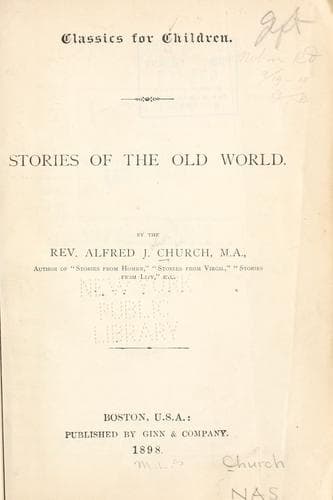
Mythology, Greek -- Juvenile literature; Mythology, Roman -- Juvenile literature
And on the other side Ajax, the son of Telamon, called to the Greeks,
and bade them quit themselves like men. Then the battle grew yet
fiercer, for Hector slew Schedius, who led the men of Phocis, and Ajax
slew Laodamas, son of Antenor, and Polydamas Otus of Cyllene. Then
Meges thought to slay Polydamas; but his spear went astray, smiting
down Cræsmus; and Dolops, who was grandson to Laomedon, cast his spear
at Meges, but the corselet stayed the point, though it pierced the
shield. But Dolops’ self Menelaüs smote through the shoulder, but could
not spoil him of his arms, for Hector and his brothers hindered him.
So they fought, slaying one another; but Hector still waxed greater
and greater in the battle, and still the men of Troy came on, and
still the Greeks gave way. So they came again, these pushing forward
and these yielding ground, to the ships. And Hector caught hold of one
of them, even the ship of Protesilaüs: him indeed it had brought from
Troy, but it took him not back, for he had fallen, slain by the hand
of Hector, as he leapt, first of all the Greeks, upon the shore of
Troy. This Hector caught, and the battle raged like fire about it; for
the men of Troy and the Greeks were gathered round, and none fought
with arrows or javelins from afar, but man to man, with battle-axe and
sword and great spears pointed at either end. And many a fair weapon
lay shattered on the ground, and the earth flowed with blood as with a
river. But still Hector held the stem of the ship with his hand, and
called to the men of Troy that they should bring fire, for that Zeus
had given them the victory that day. Then even Ajax himself gave way,
so did the spears of the Trojans press him; for now he stood no longer
upon the stern deck, but on the rowers’ bench, thrusting thence with
his spear at any one who sought to set fire to the ship. And ever he
cried to the Greeks with a terrible voice,--
“O ye Greeks, now must ye quit yourselves like men. For have ye any
helpers behind? or have ye any walls to shelter you? No city is here,
with well-built battlements, wherein ye might be safe, while the people
should fight for you. For we are here in the plain of Troy, and the sea
is close behind us, and we are far from our country. Wherefore all our
hope is in valor, and not in shrinking back from the battle.”
And still he thrust with his spear, if any of the men of Troy, at
Hector’s bidding, sought to bring fire against the ship. Full twelve he
wounded where he stood.
CHAPTER IV.
THE DEEDS AND DEATH OF PATROCLUS.
Patroclus stood by Achilles, weeping bitterly. Then said Achilles,
“What ails thee, Patroclus, that thou weepest like a girl-child that
runs along by her mother’s side and would be taken up, holding her
gown, and looking at her with tearful eyes till she lift her in her
arms? Hast thou heard evil news from Phthia? Menœtius yet lives, they
say, and Peleus. Or art thou weeping for the Greeks, because they
perish for their folly?”
Public-domain text, read in full here on John Shaqi.
Reviews
Reviews
No reviews yet
Be the first to share your thoughts on this work.
Elsewhere in the archive
Join the Discussion
Join the discussion
Sign in to leave a comment or review.
Sign InorCreate an account