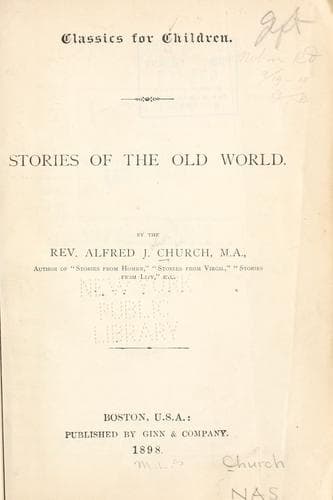
Mythology, Greek -- Juvenile literature; Mythology, Roman -- Juvenile literature
“Now must thou show thyself a good warrior, Glaucus. First call the men
of Lycia to fight for me, and do thou fight thyself, for it would be
foul shame to thee, all thy days, if the Greeks should spoil me of my
arms.”
Then he died. But Glaucus was sore troubled, for he could not help
him, so grievous was the wound where Teucer had wounded him. Therefore
he prayed to Apollo, and Apollo helped him and made him whole. Then
he went first to the Lycians, bidding them fight for their king, and
then to the chiefs of the Trojans, that they should save the body of
Sarpedon. And to Hector he said,--
“Little carest thou for thy allies. Lo! Sarpedon is dead, slain by
Patroclus. Suffer not the Myrmidons to carry him off and do dishonor to
his body.”
But Hector was troubled to hear such news, and so were all the sons
of Troy, for Sarpedon was the bravest of the allies, and led most
people to the battle. So with a great shout they charged and drove the
Greeks back a space from the body; and then again the Greeks did the
like. And so the battle raged, till no one would have known the great
Sarpedon, so covered was he with spears and blood and dust. But at
last the Greeks drave back the men of Troy from the body, and stripped
the arms, but the body itself they harmed not. For Apollo came down at
the bidding of Zeus and carried it out of the midst of the battle, and
washed it with water, and anointed it with ambrosia, and wrapped it in
garments of the gods. And then he gave it to Sleep and Death, and these
two carried it to Lycia, his fatherland.
Then did Patroclus forget the word which Achilles had spoken to him,
that he should not go near to Troy, for he pursued the men of the city
even to the wall. Thrice he mounted on the angle of the wall, and
thrice Apollo himself drove him back, pushing his shining shield. But
the fourth time the god said, “Go thou back, Patroclus. It is not for
thee to take the city of Troy; no, nor for Achilles, who is far better
than thou art.”
So Patroclus went back, fearing the wrath of the archer-god. Then
Apollo stirred up the spirit of Hector, that he should go against
Patroclus. Therefore he went, with his brother Cebriones for driver
of his chariot. But when they came near, Patroclus cast a great stone
which he had in his hand, and smote Cebriones on the forehead,
crushing it in, so that he fell headlong from the chariot. And
Patroclus mocked him, saying,--
“How nimble is this man! how lightly he dives! What spoil he would take
of oysters, diving from a ship, even in a stormy sea! Who would have
thought that there were such skilful divers in Troy!”
Public-domain text, read in full here on John Shaqi.
Reviews
Reviews
No reviews yet
Be the first to share your thoughts on this work.
Elsewhere in the archive
Join the Discussion
Join the discussion
Sign in to leave a comment or review.
Sign InorCreate an account