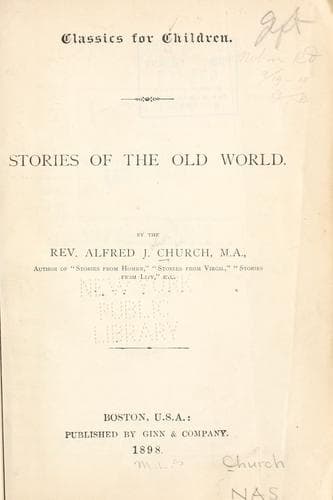
Mythology, Greek -- Juvenile literature; Mythology, Roman -- Juvenile literature
Sore dismayed was Antilochus to hear such tidings, and his eyes were
filled with tears and his voice was choked. Yet did he give heed to the
words of Menelaüs, and ran to tell Achilles of what had chanced. But
Menelaüs went back to Ajax, where he had left him by Patroclus, and
said,--
“Antilochus, indeed, bears the tidings to Achilles. Yet I doubt whether
he will come, for all his wrath against Hector, seeing that he has no
armor to cover him. Let us think, then, how we may best carry Patroclus
away from the men of Troy.”
Then said Ajax, “Do thou and Meriones run forward and raise the body in
your arms, and I and the son of Oïleus will keep off meanwhile the men
of Troy.”
So Menelaüs and Meriones ran forward and lifted up the body. And the
Trojans ran forward with a great shout when they saw them, as dogs run
barking before the hunters when they chase a wild boar; but when the
beast turns to bay, lo! they flee this way and that. So did the men
of Troy flee when Ajax the Greater and Ajax the Less turned to give
battle. But still the Greeks gave way, and still the Trojans came on,
and ever in the front were Hector, the son of Priam, and Æneas, the son
of Anchises. But in the meantime Antilochus came near to Achilles, who,
indeed, seeing that the Greeks fled and the men of Troy pursued, was
already sore afraid. And he said, weeping as he spake,--
“I bring ill news,--Patroclus lies low. The Greeks fight for his body,
but Hector has his arms.”
Then Achilles took of the dust of the plain in his hands, and poured it
on his head, and lay at his length upon the ground, and tare his hair.
And all the women wailed. And Antilochus sat weeping; but ever he held
the hands of Achilles, lest he should slay himself in his great grief.
Then came his mother, hearing his cry, from where she sat in the depths
of the sea, and laid her hand on him and said,--
“Why weepest thou, my son? Hide not the matter from me, but tell me.”
And Achilles answered, “All that Zeus promised thee for me he hath
fulfilled. But what profit have I, for lo! my friend Patroclus is dead,
and Hector has the arms which I gave him to wear. And as for me, I care
not to live, except I can avenge me upon him.”
Then said Thetis, “Nay, my son, speak not thus. For when Hector dieth,
thy doom also is near.”
And Achilles spake in great wrath: “Would that I might die this
hour, seeing that I could not help my friend, but am a burden on the
earth--I, who am better in battle than all the Greeks besides. Cursed
be the wrath that sets men to strive the one with the other, even as
it set me to strive with King Agamemnon! But let the past be past. And
as for my fate,--let it come when it may, so that I first avenge myself
on Hector. Wherefore seek not to keep me back from the battle.”
Then Thetis said, “Be it so; only thou canst not go without thy arms,
which Hector hath. But to-morrow will I go to Hephæstus, that he may
furnish thee anew.”
Public-domain text, read in full here on John Shaqi.
Reviews
Reviews
No reviews yet
Be the first to share your thoughts on this work.
Elsewhere in the archive
Join the Discussion
Join the discussion
Sign in to leave a comment or review.
Sign InorCreate an account