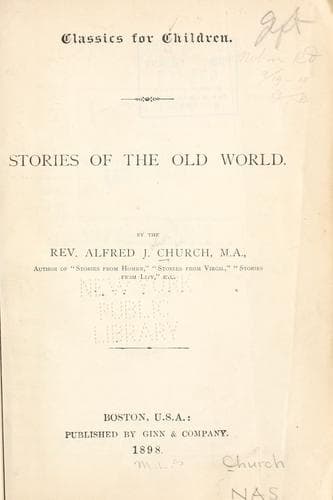
Mythology, Greek -- Juvenile literature; Mythology, Roman -- Juvenile literature
Then with a shout he rushed to the battle. And first there met him
Æneas. Now Achilles cared not to fight with him, but bade him go back
to his comrades. But Æneas would not, but told him of his race, how
that he came from Zeus on his father’s side, and how that his mother
was Aphrodité, and that he held himself a match for any mortal man.
Then he cast his spear, which struck the shield of Achilles with so
dreadful a sound that the hero feared lest it should pierce it through,
knowing not that the gifts of the gods are not easy for mortal man
to vanquish. Two folds indeed it pierced that were of bronze, but in
the gold it was stayed, and there were yet two of tin within. Then
Achilles cast his spear. Through the shield of Æneas it passed, and
though it wounded him not, yet was he sore dismayed, so near it came.
Then Achilles drew his sword and rushed on Æneas, and Æneas caught up
a great stone to cast at him. But it was not the will of the gods that
Æneas should perish, seeing that he and his sons after him should rule
over the men of Troy in the ages to come. Therefore Poseidon lifted him
up and bore him over the ranks of men to the left of the battle, but
first he drew the spear out of the shield and laid it at the feet of
Achilles. Much the hero marvelled to see it, crying,--
“This is a great wonder that I see with mine eyes. For, lo! the spear
is before me, but the man whom I sought to slay I see not. Of a truth
Æneas spake truth, saying that he was dear to the immortal gods.”
Then he rushed into the battle, slaying as he went. And Hector would
have met him, but Apollo stood by him and said, “Fight not with
Achilles, lest he slay thee.” Therefore he went back among the men of
Troy. Many did Achilles slay, and among them Polydorus, son of Priam,
who, because he was the youngest and very dear, his father suffered
not to go to the battle. Yet he went, in his folly, and being very
swift of foot, he trusted in his speed, running through the foremost
of the fighters. But as he ran Achilles smote him and wounded him to
the death. But when Hector saw it he could not bear any more to stand
apart. Therefore he rushed at Achilles, and Achilles rejoiced to see
him, saying, “This is the man who slew my comrade.” But they fought not
then, for when Hector cast his spear, Athené turned it aside, and when
Achilles charged, Apollo bore Hector away.
Public-domain text, read in full here on John Shaqi.
Reviews
Reviews
No reviews yet
Be the first to share your thoughts on this work.
Elsewhere in the archive
Join the Discussion
Join the discussion
Sign in to leave a comment or review.
Sign InorCreate an account