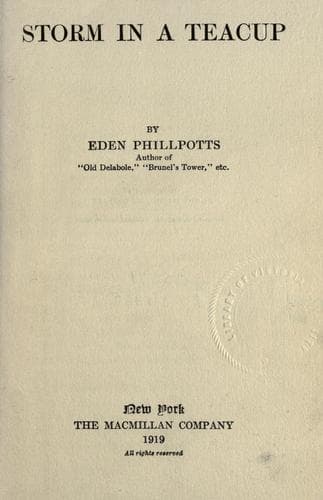
Devon (England) -- Fiction; Husband and wife -- Fiction; Man-woman relationships -- Fiction; Paper mills -- Fiction
“Don’t say that; I beg you not to put it in that way. I’m not that sort
of man.”
“I judge of a man by what he does, not by what he says. That’s what
you’ve done, and that’s what you’ll pay for sooner or late.”
“A time will come when you’ll withdraw that, Mr. Dingle. It’s a cruel
libel on my character and you’ll live to know it. At present I’m only
wishful to do things decently and in order, and I’ll ask you again to
look forward. I should be very glad to know, please, when you’re going
to go on with this? I venture to think you ought to move in the matter.”
“You beat anything I’ve ever heard of,” said Dingle. “What are you made
of—flesh and blood, or stone? To tell me my duty!”
“Why not, if you don’t see it? I’m not thinking of myself—only the
situation as it affects her.”
“And I’m thinking of it as it affects me. I’ve been pretty badly
damaged in this racket—the lawyer’s made that clear to me. I shall get
it out of you somehow—how I don’t know at present. You can clear now,
and I shan’t come to you to decide what I’m going to do about it—or
to that wicked, little fool either. Yes, a wicked, little fool—that’s
what she is—and she’ll look at home presently, when you’ve knocked the
life out of her, and find it out for herself.”
Kellock rose and prepared to depart.
“I’m sorry I called if it was only to anger you,” he said.
“Yes; and you’ll be sorry for lots of things presently I shouldn’t
wonder. You’re a fool too, come to think of it—that’s part of my
revenge I reckon—to know you, who thought yourself so wonderful, are
only a young fool after all.”
So the interview ended and Kellock went his way outwardly unruffled but
inwardly perturbed. He had never considered the possibility of Dingle
doing anything in the way of damages. He had, in fact, thought far too
little about Dingle. Ned was a man of no force of character and he had
assumed that he would proceed upon the conventional lines proper to
such cases. But Ned’s very weakness now grew into a danger, because he
was evidently in the hands of a lawyer and might be easily influenced
by a stronger will than his own. The law would probably not learn the
real human facts of the situation as between Ned and Medora. The law
never did go into these subtleties of character upon which such things
depended. Superficially the law might hold him, what he—Kellock—was
so far from being, and perhaps actually punish him in his pocket—an
event that had not entered his calculations. Did Dingle make any such
claim, it would certainly be his place to plead against it, or get a
lawyer to do so for him. He felt anxious, for he feared the law and
knew it to be a terribly costly matter to defend the most righteous
cause.
Public-domain text, read in full here on John Shaqi.
Reviews
Reviews
No reviews yet
Be the first to share your thoughts on this work.
Elsewhere in the archive
Join the Discussion
Join the discussion
Sign in to leave a comment or review.
Sign InorCreate an account