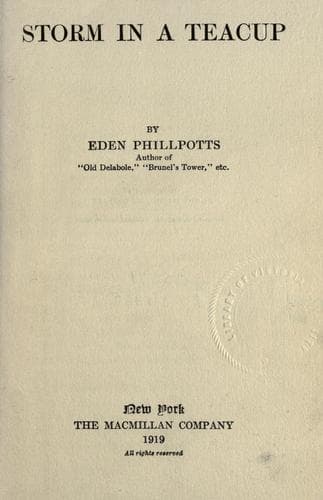
Devon (England) -- Fiction; Husband and wife -- Fiction; Man-woman relationships -- Fiction; Paper mills -- Fiction
“I’ll thank you to read this, Mrs. Trivett,” said Nicholas, as he
presented his blushing manifesto. “You may for a moment doubt whether
I ought to ask you, of all people, to sign it. I’ve been advised not.
But we’re old friends, I believe, and I know you’ll never quarrel with
the man who does his duty, even if you don’t see his duty with the same
eyes as him.”
“Duty’s often a doubtful matter,” she said, “and we mistake inclination
for duty sometimes. You can easily hoodwink yourself about duty,
Nicholas.”
She read the protest and gave it back to him and shook her head.
“Do as you think right,” she said. “But don’t ask me to sign that.
You’ll guess without being told what a sad thing this is for a mother;
but I’m not going to take sides this time of day. I’ve told them what
I think about it and how I’ve suffered over it, and I’ve told other
people also; but there’s nothing gained that I can see by this. There’s
more in it than meets the eye, and Jordan Kellock is the sort of man to
feel the punishment of his own conscience much sharper than the voice,
or vote, of his fellow men.”
“‘Conscience!’” exclaimed Mr. Pinhey. “How can you say that the man who
does a thing like that have got a conscience, Mrs. Trivett?”
“Because I know he has—so do you if you’ll think. There’s very few
so fussy and nice about life and its duties and bearings as Jordan
Kellock. We all know what he is; and until this happened, nobody
respected him more than you. And now he’s done a thing that your
conscience and mine don’t approve. But remember this, he’d never have
done it if his own conscience hadn’t supported him.”
“It was the devil getting the better of his conscience,” argued
Nicholas. “He was always weak, because he was self-righteous, though
Lord knows, seeing his foggy religious opinions, none had less reason
to be. He had got his own theory of morals seemingly, and since it
didn’t come out of the Word, it was worthless as you’d expect. So when
the trial came and your daughter—”
“Leave it, there’s a good man. I’m not going to argue upon it. I hope
they’ll soon be properly married and this sad business allowed to pass
by and be forgot. For the minute it’s up to Ned Dingle, and I’ve been
bitter sorry for him, and he knows all I think about it; but there’s no
more can be done to right the wrong and ease people who feel like you,
till Ned does it.”
“Your heart is speaking against your morals, Lydia, if I may say so.”
“You may say what you like, of course.”
“You can’t rise to the thought that it is painful for some of us to
earn our living under the same roof as that man?”
“No,” she said. “I’ve never met the man or woman so bad that I couldn’t
work under the same roof with them.”
He shrugged his shoulders.
“It’s doubtfully Christian to be so large-minded in my opinion,” he
said. “Do the other women up here think the same?”
“Alice Barefoot will sign; but her brother, Henry, will not.”
Public-domain text, read in full here on John Shaqi.
Reviews
Reviews
No reviews yet
Be the first to share your thoughts on this work.
Elsewhere in the archive
Join the Discussion
Join the discussion
Sign in to leave a comment or review.
Sign InorCreate an account