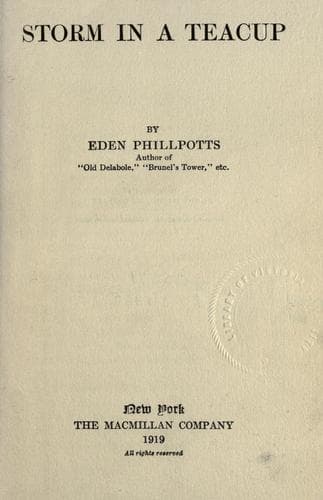
Devon (England) -- Fiction; Husband and wife -- Fiction; Man-woman relationships -- Fiction; Paper mills -- Fiction
“This is too much and I won’t stand it,” answered Mr. Pinhey. “I ask
you to recall that, Knox; or I won’t know you from this hour forward.”
“Don’t be fussy. We’re both well past our half century and can air our
opinions without getting cross. I mean that Kellock is a serious-minded
chap with a strong character and steadfast opinions. He’s just as
anxious to leave the world better than he found it as you are. And he
means to do so; and very likely, if he’s not too deadly in earnest
and too narrow in his virtues, he may. You must grant him his good
character, Pinhey, and then ask yourself whether a man with his past
would have done this without what seemed good and high reasons. I’m not
saying he was right for a minute; but I’m saying he weighed it in all
its bearings and from his mistaken and inexperienced point of view made
this big error.”
“And aren’t we here to show him his error?”
“No, we can’t show it to him. You wouldn’t convince him if you talked
for a month from your point of view. Sit tight—that’s all you’ve got
to do. I believe he’s made a big mistake and I believe he’ll see it for
himself before he’s six months older. But let his own nature work and
don’t say more till you know more. What looks like wickedness to one
man’s eye may seem goodness to another man’s.”
Mr. Pinhey had now grown calm.
“Then I won’t waste more of your time,” he answered. “You speak, I
suppose, what you believe according to reason; but I wouldn’t say you
were a very good advertisement even for reason, Knox. I know your eyes
will be opened about that man sooner or later. I can only trust that
he’s one by himself. I stand on the old paths and I believe most of us
here do the same. But if we’re going to set up Kellock and his ways as
a model, then I don’t see myself what’s to become of civilisation, or
religion either.”
He departed, completed his rounds and confessed to disappointment at
the result. Still he had mustered a respectable following and the
document he left at Matthew Trenchard’s private house that evening
was signed by twenty-eight men and women in more or less responsible
positions.
To his everlasting surprise and indignation, Mr. Pinhey never heard of
the protest again. He might as well have dropped it into the Dart, or
posted it on the west wind.
A week passed and nothing happened. Nicholas had met the master
frequently and found him just as usual—cheery, practical, busy. He
fumed in secret. He told Robert Life and old Mr. Amos Toft, who mixed
the size, that were it not for the fact that he only wanted a year to
qualify for his pension, he would resign.
Mrs. Trivett and Philander Knox discussed the matter on an occasion
when they met at close of work. It was the day on which Lydia had to
announce her decision with respect to her admirer, and they both knew
the time had come.
“We’ll give the Corkscrew a miss and go round the pond,” he said. “You
can’t talk climbing that Jacob’s ladder of a hill—at least I can’t.”
Public-domain text, read in full here on John Shaqi.
Reviews
Reviews
No reviews yet
Be the first to share your thoughts on this work.
Elsewhere in the archive
Join the Discussion
Join the discussion
Sign in to leave a comment or review.
Sign InorCreate an account