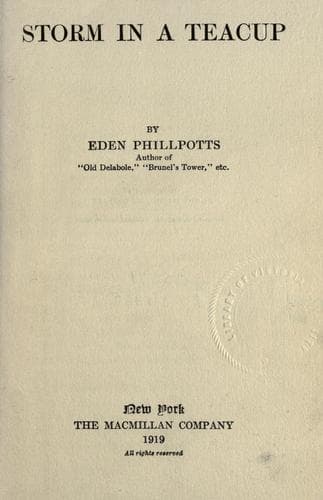
Devon (England) -- Fiction; Husband and wife -- Fiction; Man-woman relationships -- Fiction; Paper mills -- Fiction
“Speak for yourself, but not for me,” he said, “and not for your
brother, Tom, and his mate. Rabbits in a hutch have got to be looked
after, I grant, but you mustn’t believe everything you hear—even from
Tom Dolbear. Answer this: if you died to-morrow, what would happen at
Priory Farm? Why, my dear woman, in six weeks they’d have somebody
in your place who looked after the children all her time; and they’d
wonder why they never thought of that before. We won’t argue about it,
however. When you say ‘duty,’ I’m dumb, of course. But tell me this
before we drop the subject: would you marry me if things were otherwise
and your sense of duty didn’t come between?”
Mrs. Trivett was immensely relieved to find how quietly he had taken
his reverse.
“Of course I would,” she said. “You’re one of the best, and if it
hadn’t been that I’d got to work out my life same as I’m doing, I’d
have been glad enough to come to you. People at our time of day have
got judgment, if ever they’re going to have it, and in my opinion we
should have made a well-matched pair enough. But such good things are
not for me. I’ve been happily married once, and can’t expect it again.”
He continued to be quite restrained.
“I venture to think you’re about as wrong as you can be, Lydia, and
your usual good sense has gone astray. But I know duty’s your guiding
star, and I’m happy to think duty changes its shape from time to time,
like most other human contrivances.”
“I’ll always try to do it, my dear man, however it looks.”
“You will—that’s why I’m keeping so quiet now, instead of breaking out
and making a noise and lowering myself in your opinion. The beauty of
a woman like you is that you’re steadfast—a slave, if not a martyr to
what you think right. That being so, I take your word for the minute,
and leave the rest to Providence.”
She was puzzled, but very glad he could be so gentle with her.
“You’ve took it like the wise man you are,” she said. “I might have
known you would; but I was afraid you wouldn’t.”
“I haven’t took it,” he answered. “There are some things you don’t
take, and this is one of them. I’ve a great trust in the future, Lydia
Trivett. The future, though it plays many people false, have always
treated me in a very sportsmanlike and trustworthy manner so far.”
“That’s because you make your future just the same as you make your
paper, and leave nothing to chance.”
“You never spoke a truer word,” he answered. “I’m not going to brag
before the event; but if ever I was properly interested in a bit of my
future, it’s now; and if I can get the pattern right, and stamp my will
and purpose upon it, I dare say you’ll be a good bit surprised yet.”
She became uneasy.
“Don’t you meddle with fate, however. That’s not our work,” she said.
“And what would you be inclined to call ‘fate’?” he asked.
“Well,” she answered, “in a manner of speaking, you might call ‘fate’
my dear brother, Tom, and his wife. And I’ll ask you not to touch them,
Philander.”
Public-domain text, read in full here on John Shaqi.
Reviews
Reviews
No reviews yet
Be the first to share your thoughts on this work.
Elsewhere in the archive
Join the Discussion
Join the discussion
Sign in to leave a comment or review.
Sign InorCreate an account