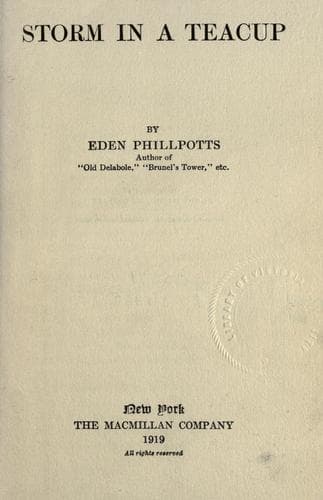
Devon (England) -- Fiction; Husband and wife -- Fiction; Man-woman relationships -- Fiction; Paper mills -- Fiction
“So you ought to be. You was always playing at being a martyr, and now
you damned well can be one. And I hope you are. The trouble with you
was that I spoiled you and fooled you to the top of your bent, and let
you bully-rag me, and never turned round and gave you a bit of the
naked truth yourself.”
“I know it,” she said. “You were a great deal too fond of me for my
good, Ned, and if you hadn’t loved me so well, I dare say you’d have
been a better husband.”
“I couldn’t have been a better husband,” he answered, “and if you’d
been made of decent stuff, you’d have known it. Not that I didn’t see
the ugly truth about you—I did; but I hoped and hoped that with time
you’d get more sense, and so I held my tongue and held on.”
“How I wish you’d told me my faults, Ned.”
“You oughtn’t to want telling. If you’d got any conscience, which you
never had, you’d have seen your faults and suffered from ’em, as you
ought. For one thing, you were greedy as the grave, and that envious
that you didn’t like anybody else to have anything you lacked. If you
saw a worm on the ground, you wished you was a bird. ’Twas always so.
Everybody else was better off than you, and had got nicer cats and
gardens and husbands and everything. A filthy jealousy it was that made
you miserable, when you ought to have been happy, and tempted you off
to try your luck with this thing, that’s only a machine, not a man.
Some chaps would have took you two and smashed your heads together
like egg-shells, as you deserved; but I’m above anything like that.
You thought I was a fool; but I wasn’t such a fool as to do that. You
wrecked me, but I wasn’t going to wreck you.”
“I’ve wrecked myself, more likely,” said Medora.
“I don’t know nothing about that. Whatever you get won’t be half what
you deserve.”
Ned appeared to have changed for the better in Medora’s eyes. The
harsher were his words, the better she liked them. Here was real
martyrdom. The emotion of this suffering became a luxury. She wept, but
was not in the least unhappy.
“I’ve ruined two very fine men—that’s what I’ve done,” said Medora.
She flung down her kingcups and bluebells, and sat on a stone and
covered her face with her pocket-handkerchief.
He looked at her fiercely, and rated her from a savage heart.
“Crocodile tears! You never even cried like a decent woman, from your
heart, because you haven’t got a heart.”
“Don’t say that,” she said. “Your heart can’t break if you haven’t got
one, and mine’s broken all right now. With all my dreadful faults, I’m
human—only too much so. I know what I’ve done, and what I’ve lost.”
“And what you’ve won, too—a lunatic, that will very likely end on the
gallows as a traitor to the country, or some such thing.”
“No, he won’t,” she replied. “He’s too dull for that.”
“You can call him dull, can you?”
“You’ve no right to make me talk about him,” answered she; “all the
same, honesty’s no crime, and I say he’s a dull man, because anybody
with only one idea is dull.”
Public-domain text, read in full here on John Shaqi.
Reviews
Reviews
No reviews yet
Be the first to share your thoughts on this work.
Elsewhere in the archive
Join the Discussion
Join the discussion
Sign in to leave a comment or review.
Sign InorCreate an account