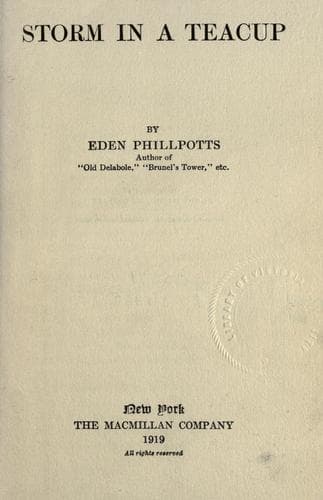
Devon (England) -- Fiction; Husband and wife -- Fiction; Man-woman relationships -- Fiction; Paper mills -- Fiction
Medora, again weeping freely, and leaving her bunch of flowers on
the ground at his feet, departed without any more words. For once,
her tears were real and her sorrows genuine. They were genuine, yet
contained a measure of sweetness, and comforted her by their reality.
This was an order of grief that she had not known. She persisted in
it for a long time, after she had gone out of his sight, and found a
sunny spot among the bluebells. There she sat and heaped reproaches
on her head; and self-blame was a sensation so novel that it soothed
instead of crushed her. But this phase passed in contemplation of Ned.
He had changed in some mysterious way. He was formidable, masculine—a
thing infinitely superior to herself. Could she dare to say that Ned
was now superior to Kellock? She fled from that thought as from chaos;
but it pursued her; it made to itself feet and wings, and clung to her
mind. She resisted, but it stuck like a burr. Ned was surely translated
into something fine and admirable; while Kellock, now about to be a
conqueror, had waned almost to a second-rate being in Medora’s vision.
A sensation of physical sickness overtook her before this horrible
discovery; for what could such a conclusion do but wreck her future
utterly and hopelessly? If Kellock were to fall from his pedestal, who
was left?
And a hundred yards off, still buried in the thoughts sprung from this
remarkable conversation, Ned set up his rod, cast out ground bait, and
began to fish for dace and perch. His mind, however, was far from his
float, and presently his eyes followed Medora, as she moved pensively
along the road on the other side of the pond. She would tell Kellock to
come and see him, and then Ned would—he did not know what he would do.
His thoughts turned to Philander Knox and their last interview. Medora
had said nothing to contradict the vatman’s assurances. Indeed, she
had implicitly supported them. And she was obviously changed. She had
apparently enough proper feeling to be miserable; but whether that
misery was pretended, or sprang from her conscience, or arose from
her futile conjunction with Kellock under the present unsupportable
conditions, Ned could not determine. He examined his own emotions
respecting Medora, and found that she had slightly modified them. He
despised her, and began even to pity her, since, on her own showing,
she was having a bad time. But was she ever built to have a good time?
Dingle doubted it.
CHAPTER XXV
THE EXPLANATION
Public-domain text, read in full here on John Shaqi.
Reviews
Reviews
No reviews yet
Be the first to share your thoughts on this work.
Elsewhere in the archive
Join the Discussion
Join the discussion
Sign in to leave a comment or review.
Sign InorCreate an account