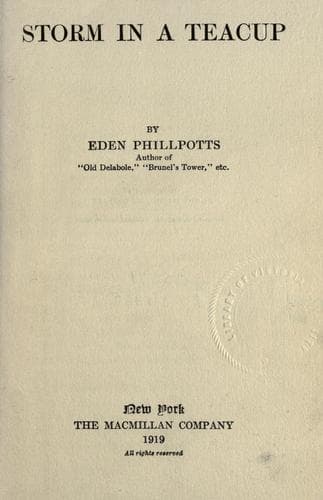
Devon (England) -- Fiction; Husband and wife -- Fiction; Man-woman relationships -- Fiction; Paper mills -- Fiction
“Yes, he would,” answered Trood. “There’s nothing in the world, even as
it’s run now, to stop brains. There’s boys who were charity school boys
thirty years ago that the world listens to very respectfully to-day.
But Kellock’s let a lot of class hatred come into his talk, and hatred
breeds hatred. Never a man wanted power more than him, but his sort
go the wrong way to work with their bluster and threats. They don’t
help: they’re out for blood. We’re a very fair country at heart and
under our constitution we’ve grown to be the finest people on earth.
So, naturally, as a whole, the nation don’t want the Constitution swept
away till we can get a better. The socialists have no traditions, and
don’t agree among themselves yet, and I for one wouldn’t trust people
that scoff at tradition and want to be a law to themselves. They would
be a great danger, Henry, and if we got all to pieces like that and in
sight of civil wars and revolution, we should throw ourselves open to
attack from our enemies. Then, while we were wrangling how to govern
ourselves, we’d damn soon find England was going to be governed by
somebody else.”
“There’s plenty of hungry eyes on the British Empire no doubt,” allowed
Mr. Barefoot.
“Plenty; and if our army and navy got bitten with this stuff, it would
be good-bye to everything. And that wouldn’t suit Kellock’s friends.”
“And be it as it will,” said Daisy Finch, “a paper mill isn’t a
charity. Those that run the Mill have got to live, I suppose.”
“Yes, Daisy,” admitted Trood; “but we must be fair to this Kellock,
though I’m far from supporting what he says. The ills are as he
stated them; the remedies are not as he stated ’em. He argues that
the workman’s work should no more be his whole life than work is his
master’s whole life. Because Capital buys a man’s working hours, it
doesn’t buy his life and liberties. Outside his work, he’s as much
right to enjoy being alive as his employer. A machine looks very
different from the owner’s point of view and the worker’s. The owner’s
the master of the machine; the worker is its slave; and it’s on the
worker the machine puts the strain, not on the owner. So we have got
to consider our working hours in relation to our lives as a whole,
and balance work against life, and consider how our labour affects our
existence. A six hour day at a machine may be a far greater tax on a
man or woman than an eight hour day at the desk, or the plough. You’ve
got to think of the nervous energy, which ain’t unlimited.”
Public-domain text, read in full here on John Shaqi.
Reviews
Reviews
No reviews yet
Be the first to share your thoughts on this work.
Elsewhere in the archive
Join the Discussion
Join the discussion
Sign in to leave a comment or review.
Sign InorCreate an account