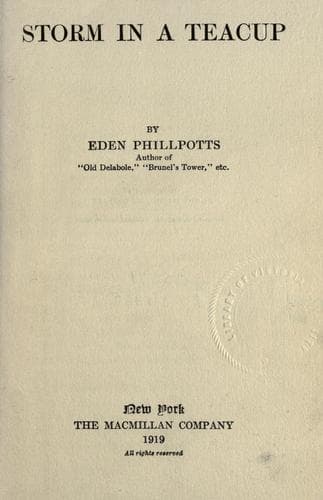
Devon (England) -- Fiction; Husband and wife -- Fiction; Man-woman relationships -- Fiction; Paper mills -- Fiction
At the Museum he surprised her by the extent of his knowledge. She had
heard enough by the time they went to lunch and better liked the Park,
where they sat for a while in the afternoon. Medora saw wealth and
beauty and power pass by while Kellock commented.
“That’s the sort of thing we’re out to alter,” he said. But she was not
feeling in a socialistic mood.
“Why?” she asked. “Why shouldn’t there be beautiful horses and
beautiful clothes in the world?”
“It isn’t the horses and clothes. It’s where they come from, Medora.
The horses are bred for money, and the clothes are spun and made for
money. But who makes the money? Do the people that ride the horses and
wear the clothes make it? No—you and I make it. The workers make it.
You and I have just as much right to ride in a carriage as the Queen of
England.
“The wealth of the world is exploited,” he explained, “and the result
is poverty and superfluity. The world could get on perfectly well
without those horses and those clothes—yes, and those people; but it
couldn’t get on without us. We’re carrying on the work of civilisation,
not those dolls and puppets toying together. Poverty and wealth are
the result of the same vicious factor in our social system. They are
interdependent and spring from the same rotten roots. Banish poverty
and you do away with hunger and ignorance and misery and immorality
and other ills, all of which spring from it. And there’s only one
way to banish poverty, and that’s to banish wealth. Then you get a
self-respecting order of humanity instead of the present arrangement.
If the nation’s rich, the people are rich. It all comes back to brain
power, and the moment labour is strong enough in brain power, the rest
follows. The Trade Unions are only a first little instalment. In fact
they’re almost past their work now. We’ve gone beyond them. Syndicalism
says good-bye to the poor and good-bye to the rich. Then we shall get
face to face with reality.”
“And what becomes of all these handsome, dashing, prosperous people
then?” she asked.
“Nothing worse than what becomes of us. They will be left with a great
deal more than they deserve, because they’ve never lifted their fingers
to help the real good of the world. The revolution in this country,
when it comes, will be bloodless—merely a readjustment in conformity
with reason and justice. We’re out against the system, not against the
individual which battens on it. When we make war on rats and sparrows
and wood pigeons, we’re not quarrelling with the individual rat or
sparrow, but against the class. They’ve got to go, because they’re
unsocial and harm the community and take for themselves what was grown
and garnered for their betters. And that’s what the classes are doing.
They take for themselves what was earned by their betters.”
“Why are we their betters?”
Public-domain text, read in full here on John Shaqi.
Reviews
Reviews
No reviews yet
Be the first to share your thoughts on this work.
Elsewhere in the archive
Join the Discussion
Join the discussion
Sign in to leave a comment or review.
Sign InorCreate an account