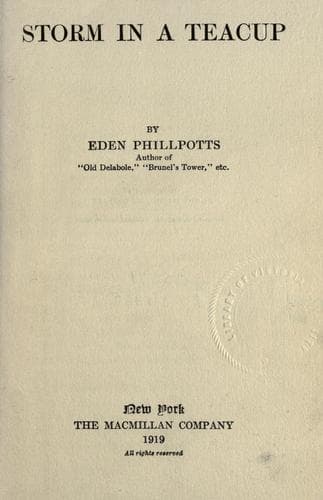
Devon (England) -- Fiction; Husband and wife -- Fiction; Man-woman relationships -- Fiction; Paper mills -- Fiction
He made no other allusion to the previous night and Medora’s wonderful
eyes bent upon him with apparent adoration, while her wonderful heart
grew a little hard. She remembered that she had been married and he
never had.
“You’re a saint,” she said.
“Oh, no—only a clean-minded, honourable man, Medora.”
She fell asleep gently hating him that night; but after many hours of
dreamless slumber, she awoke in better spirits and found herself loving
Kellock again. He was a hero and somewhat abnormal, as heroes must be;
but, after all, she was a heroine, and should therefore find no supreme
difficulty in rising to the heights on which he moved. She saw indeed
that this would be necessary if she wished to be happy.
She met him radiantly next morning and he found her mood easy and
humble. He knew a man at Doulton’s Pottery, and when he suggested going
to see the famous works, she agreed.
“We shall be among our own sort there,” he said. “It will be good for
us. I don’t think sitting in Hyde Park watching the rich was good for
us. I may have said a bit more than I meant about them. They’re not all
worthless wasters, of course, and it’s quite true what you said, that
there may be a bit of class prejudice in me.”
“No, there isn’t—not a scrap,” she answered. “And if there is, they
deserve it. Nobody looks all round things like you do. You’ll live to
see it all altered no doubt, and do your bit to help alter it.”
“If I had my way, them that don’t work shouldn’t eat,” he declared.
“Work’s the saving of mankind, and you can’t be healthy-minded if you
sit and look on at life, any more than you can be healthy-bodied if you
take no exercise. We all owe a lot to every one else, and them that
won’t pay that debt and want to take all and give nought, are wicked
enemies to the State.”
At Doulton’s Medora was genuinely interested, and best she liked the
painting rooms.
“That’s beautiful work,” she said. “If I’d been brought up to that,
I’d have joyed in it, because there’s something to show for it, and
you’d know the flowers and ribbons you painted was brightening up other
people’s homes. But my work—just shifting paper and putting the zinc
between the sheets for the glazing rollers—there’s nothing to it.”
“Don’t you say that. All necessary work is fine if it’s done well, same
as you did it. But there’ll be no more of that sort of work for you.
Your place will be at home; and I shouldn’t be content for you just to
do housewife’s work neither, Medora. You’re going to be my right hand
and look after my papers and help me with the big things I hope to
do—not in the Mill, but out of it.”
“I never shall be clever enough.”
Public-domain text, read in full here on John Shaqi.
Reviews
Reviews
No reviews yet
Be the first to share your thoughts on this work.
Elsewhere in the archive
Join the Discussion
Join the discussion
Sign in to leave a comment or review.
Sign InorCreate an account