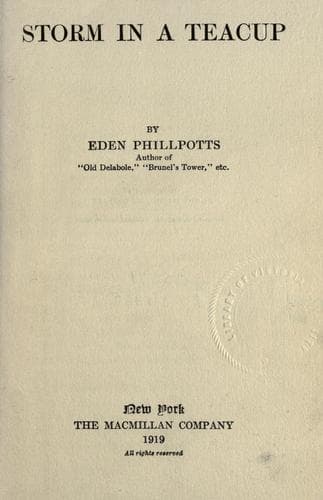
Devon (England) -- Fiction; Husband and wife -- Fiction; Man-woman relationships -- Fiction; Paper mills -- Fiction
“I don’t say that; yet I don’t deny it. I have thought about you.
You’re a good chap and very restful to the nerves; and your sense,
coming on the foolishness of some people, shows up in a bright light.”
“You’ve hardly seen a twinkle of it yet, Lydia. I don’t want to blow my
own trumpet, or nothing like that; but with all my faults, you’d find
the sense was here, and the patience.”
“You’re a marrying sort of man, no doubt, and you’ve got all the
makings of a good, restful husband—I see that too. But I reckon you
haven’t looked round far enough yet. There’s a lot against me. I ain’t
a free woman by any manner of means, and you don’t want to be saddled
with my troubles. That’s the worse of marriage in my opinion. A man
says, ‘I take the woman and not her family,’ and the woman says the
same; but things don’t fall out like that in life. There’s always the
families, and nobody can escape from ’em.”
“True, but we can be very good friends with our relations without
doing nursemaid’s work for ’em as well as our own work. ’Tis time you
stopped working altogether in my opinion, and had a bit of rest and
comfort to your life—such a dignified creature as you are by nature.
The farm gets stuffier and stuffier and you can’t deny it. It will tell
on your health and break you down. So why not do as I beg of you and
come to me?”
“Have you ever thought of that nice woman, Alice Barefoot?” asked Lydia
suddenly, and Mr. Knox stopped dead, stared at her through the gloaming
and mopped his head and neck again.
“Good God! What d’you mean?”
“A woman without a care or encumbrance and—”
“Stop,” he said. “That’s not a worthy remark, and I’ll start to forget
and forgive it, if you please, this moment. If you just think all
that goes to such a speech as that, you’ll be sorry you made it. A
man tells you he loves you, and you say ‘Try next door.’ That’s bad
enough in itself; but there’s more to it and worse even than that. For
it means either you don’t know Alice, or you don’t know me. You ought
to understand perfectly well that a woman like her is no more use to
me than a Red Indian. And you do know it; and if you’d thought half a
minute, you’d never have let yourself say such a wild and unkind and
silly thing as that. It shows a very great lack of interest in me—far
less interest than I thought you felt in fact. I’m shook, Lydia; I
thought we understood each other better.”
“She’s a fine and a good woman,” said Mrs. Trivett feebly.
“Good she may be, in a bleak sort of way; fine she is not and you know
it. Besides, surely at my time of life a man wants a mind, if he’s
got one himself. No doubt you think the world of Alice Barefoot; but
even you ain’t going to argue she’s got more mind than would go on a
three-penny piece and leave a margin.”
“I’m sorry—I was quite wrong,” confessed Lydia.
“You were, and since you’re sorry, enough said. I’ll resume another
time. Here’s the top and I won’t go no farther to-night. You ain’t
yourself, I’m afraid.”
Public-domain text, read in full here on John Shaqi.
Reviews
Reviews
No reviews yet
Be the first to share your thoughts on this work.
Elsewhere in the archive
Join the Discussion
Join the discussion
Sign in to leave a comment or review.
Sign InorCreate an account